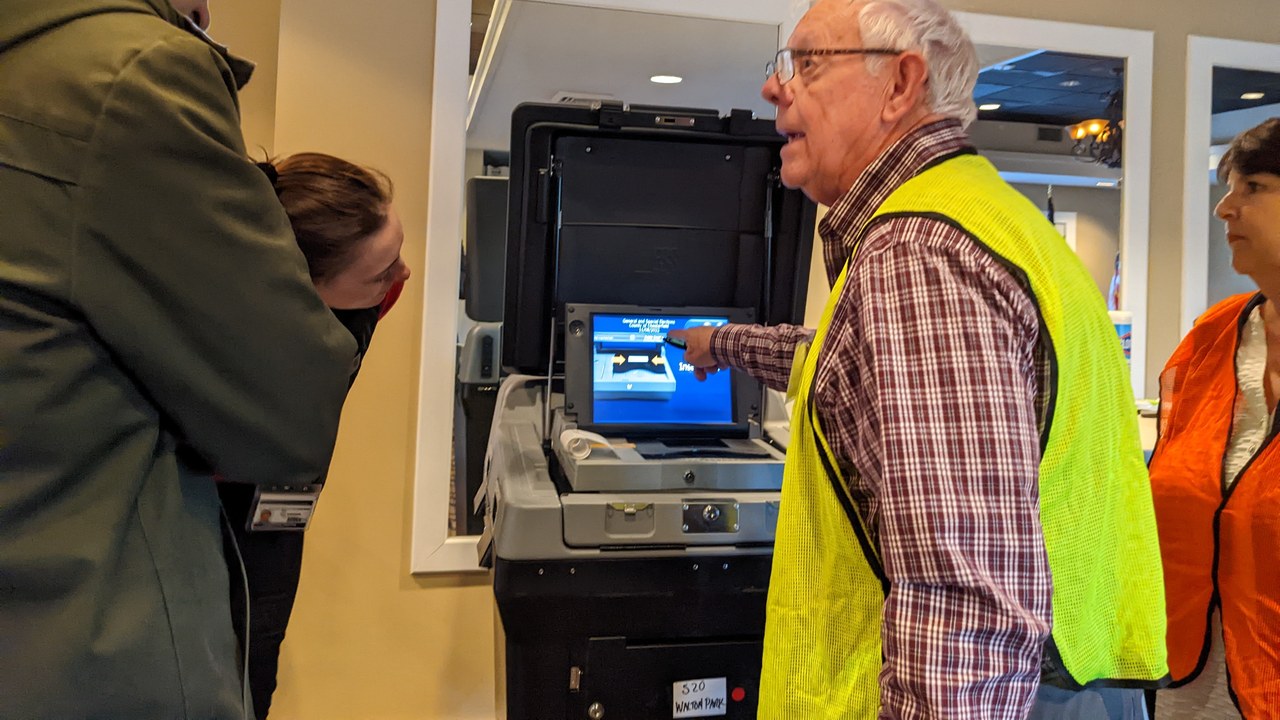
Poll workers and other election staff paid $2,700 or more in 2027 owe Social Security and Medicare taxes on that pay. The Social Security Administration set the 2027 threshold for election officials and election workers at $2,700 in its annual determinations notice, which is scheduled to appear in the Federal Register on Oct. 26.
The question for anyone who staffs a polling place, often a retiree, is whether their own pay is covered. The notice calls the figure “the minimum amount an election official and election worker must earn” for the earnings to be covered under Social Security or Medicare, and says: “For 2027, this threshold is $2,700.” A worker paid $2,700 or more by a city, county or state in 2027 is over the line.
What changed this year: Social Security and Medicare change every year, and nobody sends you a memo. The Retirement Money Brief breaks down what changed and what to do.
Get the Retirement Money Brief →
We may earn a commission from links on this page.
How the $2,700 figure is set
The number is a formula result, not a round choice. It starts from the 1999 amount of $1,000 and scales it by the change in the national average wage index under section 218(c)(8)(B) of the Social Security Act. The unrounded 2027 result is $2,654.43, and the notice rounds it to $2,700.
The figure moves up with wages. The Social Security Administration’s page for election officials and election workers lists the exclusion at $2,300 a calendar year for 2024 forward, and $2,200 for 2023. The IRS says the federal threshold was $2,000 from Jan. 1, 2021, adjusted for inflation since.
Why coverage depends on the state
Election workers are public employees, so the rules turn on the state. Under a Section 218 agreement, the deal each state struck with Social Security for its public workers, the agreement’s terms decide. SSA says many states exclude election workers paid below the threshold. Where an agreement has no election worker exclusion, SSA says “Social Security and Medicare taxes apply from the first dollar paid.”
Some agreements set lower thresholds than the federal amount, such as $50 per calendar quarter or $100 per calendar year. Election workers in a place without a Section 218 agreement fall under mandatory coverage, and the IRS says that once such a worker is paid the federal threshold or more, FICA applies from the first dollar.
What the taxes cost
The two taxes are together known as FICA. The IRS household employer guide puts the rates at 6.2 percent for Social Security and 1.45 percent for Medicare, 7.65 percent combined, paid by the employer and matched by the worker. For an election worker paid exactly $2,700, the worker’s side of that would be about $207.
Because the tax applies from the first dollar once a worker reaches the threshold, a worker paid $2,700 owes on the whole $2,700, not just the part above it. The wages also count toward the worker’s own Social Security record, since coverage is what makes pay count toward benefits.
What retirees who work elections should check
SSA refers state and local government employers, and by extension their workers, to the Election Worker Coverage chart and to State Social Security Administrators for the state-by-state picture. A county elections office can say whether its state’s agreement excludes election pay below the threshold or taxes it from the first dollar.
For a retiree already collecting Social Security, election pay is also income that goes on the tax return. The $2,700 threshold sets when FICA applies. It does not say how much federal income tax the same wages add to a retiree’s year.
What stays unsettled for each worker
The federal threshold is fixed at $2,700 for 2027, and the notice states it without conditions. What differs is the local rule beneath it: a state with a lower threshold taxes election pay sooner, and a state with no exclusion taxes it from the first dollar.
Any election worker expecting 2027 pay near $2,700 can compare it against the figure in the notice and against the state agreement. The open question is which side of the line a particular year’s pay lands on.
Working elections in 2027 and collecting Social Security?
Election pay that crosses $2,700 means payroll tax taken from the wages, and it also raises the income that decides how much of a Social Security benefit is taxed. A retiree who misjudges that total can end up with a larger tax bill than expected in April.
The Retirement Tax & Withdrawal Planner includes four calculators (provisional income, IRMAA tier, RMD schedule, Roth bracket fill), the senior deduction and the account withdrawal order. The provisional income calculator is the one built for working out how outside earnings feed into tax on Social Security; the kit does not cover election-worker payroll rules.
Get the provisional-income calculator and planner for a retiree with election pay →
More Financial Reading
- 21 Ways to Stretch a $2,087 Social Security Check
- 15 Places to Find Your Share of the $4.25 Billion States Give Back
- 15 Ways Retirees Are Tapping a Record $14.9 Trillion in Home Equity
This article was produced with AI assistance and edited for accuracy against the sources linked above.