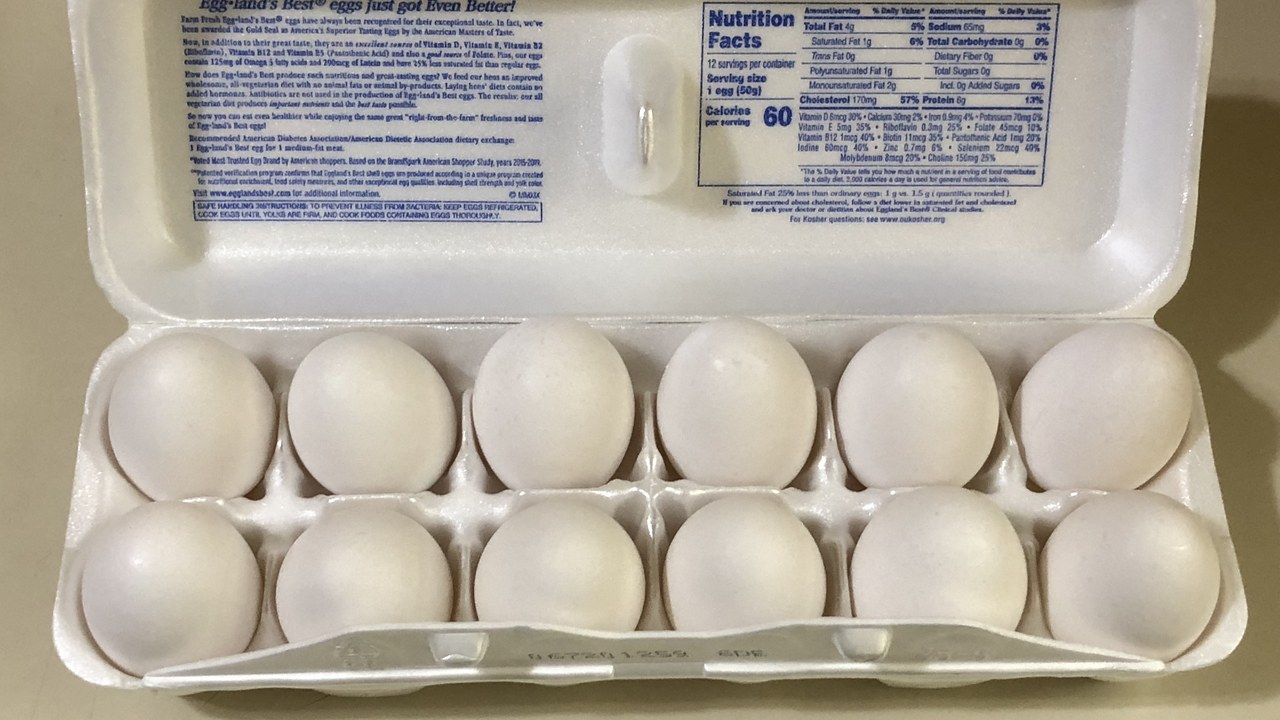
A carton of eggs that cost close to $6 during last year’s bird-flu shortage is cheaper again this fall, but not nearly as cheap as the price farmers are now getting. The U.S. Department of Agriculture’s Economic Research Service forecasts that farm-level egg prices will end 2026 down 82.1 percent from 2025, while the price you pay at the register is forecast to fall only 30.8 percent. That roughly 51-point gap is the story: most of the collapse happening on the farm side has not made it to your cart.
USDA’s Own Numbers Expose The Farm-To-Shelf Gap
In its August 25, 2026 Food Price Outlook update, which incorporates July 2026 Consumer Price Index and Producer Price Index data, ERS projects farm-level egg prices falling 82.1 percent for full-year 2026, with a 95-percent confidence range of minus 85.5 to minus 75.2 percent. Retail egg prices, measured through the Consumer Price Index for food at home, are forecast to fall just 30.8 percent, with a range of minus 35.3 to minus 25.3 percent. For every dollar the wholesale side of the egg market has given back, the amount showing up on your receipt is less than half that.
The gap already shows up in real, non-forecast numbers too. Farm-level egg prices in July 2026 were 79.0 percent below July 2025. Retail egg prices in July 2026 were only 25.7 percent below the year before. Same direction, same rough proportion, and it is already happening, not just projected.
Free retirement updates: Keep more of your Social Security and savings with plain-English updates on the changes, deadlines, and costly mistakes retirees miss. Subscribe free.
Bird Flu Drove The Spike; A Production Rebound Is Unwinding It
The gap only makes sense once you know why farm egg prices spiked so hard in the first place. An ongoing outbreak of Highly Pathogenic Avian Influenza that began in 2022 has repeatedly wiped out egg-laying flocks, and the farm-level price swings have been extreme: up 163.1 percent in 2022, down 28.3 percent in 2023, up 43.1 percent in 2024, and up 31.6 percent in 2025, according to the same ERS release. Retail prices moved far more mildly through all of it, rising a comparatively tame 32.2 percent in 2022 and 21.9 percent in 2025.
What has changed in 2026 is supply, not demand. USDA is projecting an increase in egg production in 2026 over 2025, and there were fewer new HPAI detections in the first quarter of 2026 than in the first quarter of 2025. As detailed in the ERS Livestock, Dairy, and Poultry Outlook, the availability of replacement pullets has been sufficient in 2026 to cover both routine flock turnover and unpredictable HPAI-related losses, a point the agency first flagged in its April edition of the same report. More hens laying more eggs means more supply chasing the same grocery demand, and that is what is pulling the farm price down so fast.
That is also why the 2026 crash looks so different from the 2022 spike. In 2022, a shrinking flock met steady demand and farm prices tripled in a matter of months. In 2026, a recovering flock is meeting the same demand, and the price is unwinding in the other direction, only faster than retailers can, or will, adjust their shelf tags.
Farm Egg Prices Already Bounced 27 Percent In A Single Month
The 82.1 percent full-year forecast is not a straight line down, and that matters for how much further relief you should expect. Farm-level egg prices actually rose 27.3 percent from June 2026 to July 2026, even while sitting 79.0 percent below where they stood a year earlier. ERS tracks these swings through the Producer Price Index, described on the outlook’s overview page as a measure of what is paid to farmers, which the agency itself notes is “typically far more volatile” than the retail-facing CPI. A one-month, near-30-percent jump at the farm level is a signal that the deepest part of the price collapse may already be behind us, not still coming.
Why Grocery Shelves Never Pass Along The Full Drop
None of this means your grocer is pocketing the difference through some hidden scheme. ERS explains the mechanics plainly: price volatility decreases as products move from the farm to the wholesale sector to the retail sector, because processing, packaging, transportation, labor, and shelf space all add costs that do not rise or fall with the price a farmer gets for a case of eggs. The agency’s own documentation on how it builds these forecasts notes that the CPI for food “typically lags movements in the PPI” for exactly this reason. When farm prices spike, retailers do not pass along the full increase immediately; when farm prices crash, they do not pass along the full decrease either. The same buffer that kept your grocery bill from tripling in 2022 is the reason it is not being cut in half now.
That buffer is not new, either. ERS research on farm-to-retail pass-through in other food categories has found the same pattern for decades: wholesale-to-retail price transmission is consistently weaker than farm-to-wholesale transmission, whether the commodity is eggs, beef, or bread. Grocery pricing tends to move up quickly and down slowly, a pattern economists sometimes call “rockets and feathers.” Eggs in 2026 are behaving exactly like the textbook case.
Your Next Carton Of Eggs, By The Numbers
If you are deciding how much room to leave in your grocery budget for eggs this fall, the honest answer is: some relief, not a windfall. The steepest declines already happened at the farm level, where a rebound in hen flocks met an oversupplied market. What lands in your cart is a smaller, steadier discount, built up over many months rather than delivered all at once. It also means the egg aisle is a poor place to look for a dramatic bargain right now, even in a year when the wholesale market has essentially reversed itself. USDA’s own tally puts your actual discount at 30.8 percent for the year, with a July farm-price rebound suggesting the number will not move much further before 2026 closes out.
This article was produced with AI assistance and reviewed by a human editor. Figures are linked to their primary sources; where a claim could not be verified from the public record, we say so.
More Financial Reading