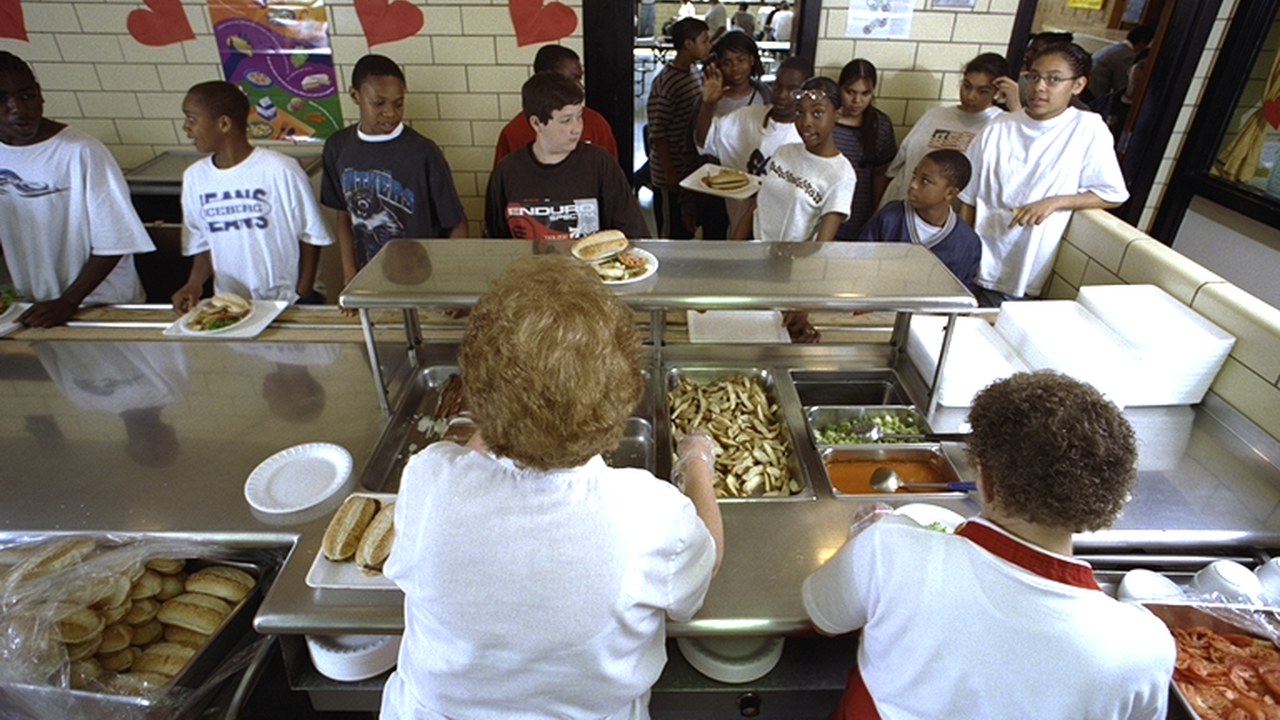
Federal rules updated this year let a household of four bring home as much as $61,050 a year, or $5,088 in a single month, and still qualify for reduced-price meals at school. That threshold sits well above what most people picture when they hear “poverty guideline,” and the gap is intentional: the reduced-price cutoff is set at 185 percent of the federal poverty line, not 100 percent. For a household with income that moves around from overtime, seasonal work, or a second job, knowing exactly where that line falls can decide what a child’s lunch costs every school day this year.
How USDA Builds the 185 Percent Threshold
The Food and Nutrition Service’s income eligibility notice, published in the Federal Register on April 9, 2026, lays out the math behind the number: the agency takes the year’s federal poverty guidelines, issued separately by the Department of Health and Human Services, and multiplies them by 1.85 for reduced-price eligibility and by 1.30 for free eligibility, rounding each result up to the next whole dollar. Those guidelines run from July 1, 2026 through June 30, 2027, and the notice states plainly that the family-of-four figures “represent an increase of 2.6 percent over last year’s level.” The Pennsylvania Department of Education’s published version of the same federal chart shows the resulting numbers in dollar terms: a household of four lands at $5,088 a month, or $61,050 a year, for reduced-price meals, and at $3,575 a month, or $42,900 a year, for free meals. Every additional household member raises the reduced-price line by roughly $876 a month.
Free retirement updates: Enrollment and claim windows come and go, and missing one can cost you real money. The free Retirement Shield newsletter keeps you ahead of the deadlines that matter. Sign up free.
What Counts as Income Under the Guidelines
The notice defines income broadly and before deductions, which matters for households trying to figure out where they land on the chart. Wages, tips, commissions, self-employment earnings, Social Security, pensions, veterans’ payments, alimony, child support, unemployment compensation, and even withdrawals from savings or trust accounts all count toward the total used to determine eligibility. Taxes, insurance premiums, and retirement contributions are not subtracted first. Benefits explicitly excluded from other federal programs by statute stay excluded here too, and the value of the school meals themselves is never counted as income against a household’s eligibility for other assistance programs.
How the Line Moves With Household Size
The same table that produces the $5,088 figure for a household of four runs from one person up through eight, and it does not scale evenly. A single-person household clears the reduced-price threshold at $2,461 a month, while a household of eight can earn up to $8,591 a month and still qualify. Every additional person beyond eight adds roughly $876 a month to the reduced-price line, the same increment used for households of five through eight. On the free-meal side of the same chart, the spread runs from $1,729 a month for one person up to $6,037 a month for a household of eight, a threshold that runs roughly two-thirds of the corresponding reduced-price number at every household size.
Programs Riding on the Same Chart
The income figures apply well beyond the cafeteria line. The same guidelines set eligibility for the National School Lunch Program, the Commodity School Program, the School Breakfast Program, the Special Milk Program, the Child and Adult Care Food Program, the Summer Food Service Program, and the Summer EBT program known in many states as SUN Bucks. Summer EBT, formally the Summer EBT for Children Program, delivers a grocery benefit loaded onto a card for eligible children during months when school meals are not in session. A household that qualifies under the reduced-price or free thresholds for school lunch generally qualifies across that entire list, without filing a separate application for each one. North Carolina’s Department of Public Instruction confirmed the same July 2026 rollout for its schools and noted that households already receiving SNAP or Cash Assistance benefits are certified automatically, without submitting the income application at all. Foster children under the legal responsibility of a court or social services agency are categorically eligible for free meals regardless of the income of the household they live with.
Why the Line Sits Above the Poverty Guideline
Congress built the multiplier into the underlying law decades ago specifically so eligibility would not track poverty status alone, and the effect shows up clearly in this year’s chart: a family of four earning nearly $20,000 above the poverty line can still receive reduced-price meals, while one earning roughly $9,000 above it qualifies for free meals outright. The Food and Nutrition Administration’s posting of the notice lists Penny Burke at the Program Monitoring and Operational Support Division as the contact for questions, and the underlying document was signed by Patrick A. Penn, Deputy Under Secretary for Food, Nutrition, and Consumer Services, before its April 9 filing. The notice itself runs across four pages of the Federal Register, filed under document number 2026-06842 and assigned citation 91 FR 17932, and it covers five separate federal assistance listings tied to the National School Lunch Act and the Child Nutrition Act of 1966. Because the guidelines are tied to the calendar Consumer Price Index rather than a fixed dollar figure, the threshold moves every July, which is why the $5,088 figure that applies for the 2026-27 school year is not the same number that applied a year earlier, and will not carry forward unchanged next summer.
A Parallel Set of Income Charts for Older Households
Household-size income tables like the one behind reduced-price meals govern a separate group of programs aimed at people past working age, and those run on the same opt-in logic: SNAP applies relaxed rules once a household member turns 60, LIHEAP helps with home energy costs, and most states run some form of senior property-tax relief. None of them certify a household automatically the way SNAP participation certifies a child for school meals. Older households are left to find each chart on their own, and a great many never do, which is why benefit money sits unclaimed year after year.
The Benefits Checklist is a 63-page guide covering 11 programs, with the 2026 income limits for each and a printable tracker for the paperwork.
Read the 2026 income limits for every program on the list in The Benefits Checklist.
This article was produced with AI assistance and reviewed by a human editor. Figures are linked to their primary sources; where a claim could not be verified from the public record, we say so.