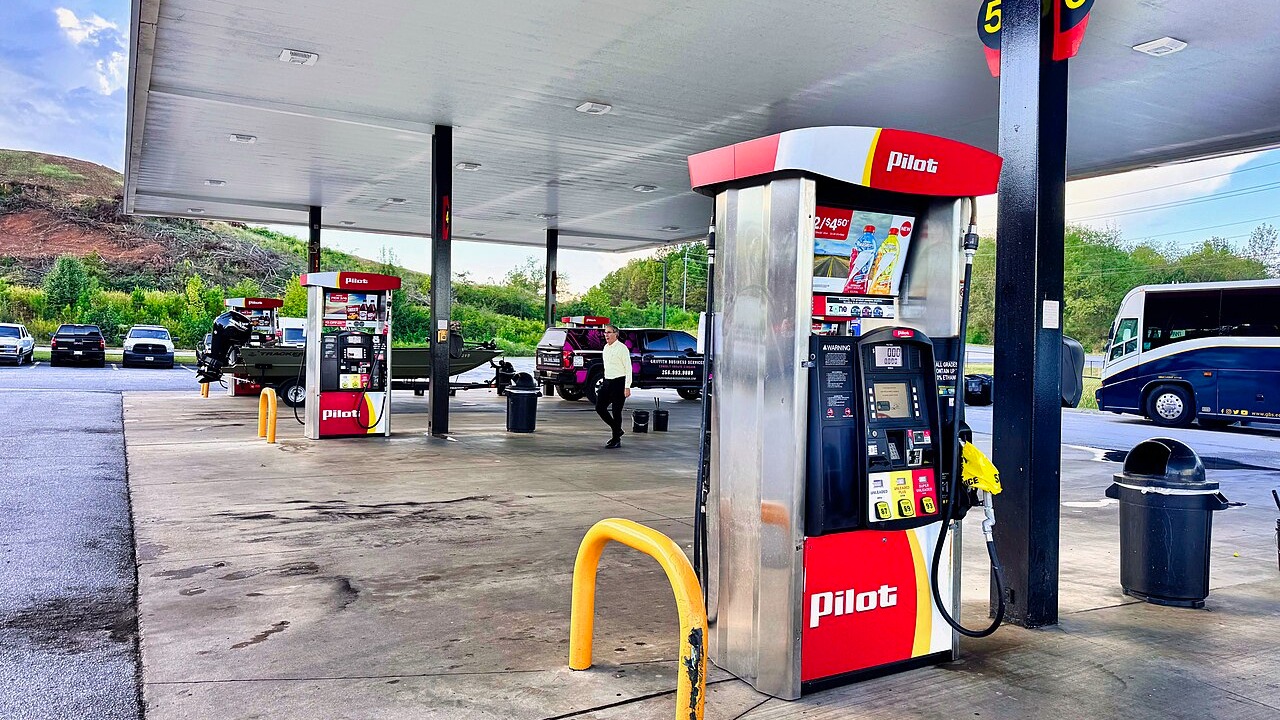
Forty gallons a month is an ordinary amount of fuel for one household with one commuting driver. At the second quarter’s pump prices, that tank-and-a-half habit cost roughly $168 a month. At the price the federal government now projects for the last three months of the year, the same 40 gallons runs about $136. The gap is roughly $32 a month, or close to $96 across the quarter, and it is the difference between two numbers in a single federal forecast rather than anything that has happened at a pump yet.
The July 7 outlook puts fourth-quarter gasoline near $3.40 a gallon
The projection comes from the Energy Information Administration, the statistical arm of the Department of Energy, which publishes a monthly forecast of fuel and power prices. Its current edition was released on July 7, 2026, with the forecast itself completed on July 1.
That outlook has retail gasoline averaging just under $3.80 a gallon in the third quarter, down from more than $4.20 in the second, and then falling to around $3.40 a gallon in the fourth quarter. For the full year, the Short-Term Energy Outlook projects a national average of $3.64 a gallon in 2026 and $3.09 in 2027. Every one of those figures is a forecast, not a reading.
The revision behind them is large. A month earlier, in the June edition, the same agency had 2026 gasoline at $3.90 and 2027 at $3.64. The July numbers cut those by 6.5% and 15.1%. On 480 gallons a year, the roughly 55-cent gap between the 2026 and 2027 annual averages works out to about $264 in a household’s fuel budget.
Free retirement updates: Household bills rarely rise in isolation. The free Retirement Shield newsletter connects the changes that matter to working families and retirees. Read it free.
Crude oil moved first, and the Strait of Hormuz is why
Gasoline follows crude. The outlook attributes the markdown to a sharp turn in the oil market after the United States and Iran signed a memorandum of understanding on June 18 to end the conflict and open the Strait of Hormuz, which allowed the agency to raise its expectations for global oil production through the rest of the year.
The price move was immediate. Brent crude, the global benchmark, averaged $85 a barrel in June, down $22 a barrel from May and $32 a barrel from its April 2026 peak. EIA’s forecast has Brent averaging $74 a barrel in the third quarter and falling to an average of $65 a barrel in 2027. For the full year, the Brent forecast dropped from $95 a barrel in the June edition to $82 in the July one.
Crack spreads explain why the pump lags the barrel
Cheaper crude does not reach a gas station one-for-one, and the outlook is unusually specific about the leak. Lower crude prices alone would have pulled third-quarter gasoline down by almost 50 cents a gallon. The actual projected decline is about 41 cents, because refining and retail margins are widening at the same time.
The mechanism is the crack spread, the difference between the wholesale price of gasoline and the price of the crude oil it was made from. Gasoline inventories fell below their five-year range in April and May as refiners chased jet fuel and distillate production, and tight inventories keep that spread elevated. The petroleum products section of the outlook estimates the gasoline crack spread widens by about 10 cents a gallon on average in the third quarter.
The fourth-quarter number depends on that reversing. As inventories restock and the summer driving season ends, the forecast has competitive pressure narrowing crack spreads significantly, which is what carries retail prices down to around $3.40. If inventories rebuild more slowly than projected, that is the piece of the arithmetic most likely to give.
Diesel is moving the other way
A household that drives a diesel pickup, or a small business that runs one, is looking at a different line in the same table. Retail diesel is projected to average $4.61 a gallon in 2026, against $3.66 in 2025 and $3.76 in 2024. For 2027 the projection is $4.02. Diesel, unlike gasoline, is forecast to sit well above where it has spent the past two years.
The 95-cent step between the 2025 diesel average and the 2026 projection runs in the opposite direction from gasoline, which is forecast to rise from $3.10 in 2025 to $3.64 in 2026 and then fall back to roughly its 2025 level in 2027. Crude itself is projected lower on both counts: West Texas Intermediate, the domestic benchmark, averages $76 a barrel in the 2026 forecast and $61 in 2027, against $65 in 2025. The spread between what crude costs and what a gallon of diesel costs is a refining and distillate-demand story, not a crude story.
The next update lands August 11
A forecast is a statement about the future made with the information available on a particular date, and this one was completed on July 1. Hurricane damage to Gulf Coast refining, a refinery outage, or a reversal in the oil market could all move the fourth-quarter figure before the fourth quarter arrives. The outlook also expects gasoline consumption in the second half of 2026 to run below its five-year average, partly because of higher prices and economic conditions, which is itself a reminder that demand assumptions are baked into the price.
The useful discipline for a household planning a fall budget is to treat $3.40 as a projection with a known expiration date. EIA’s own release schedule puts the next Short-Term Energy Outlook on August 11, 2026. Until then, the July 7 edition is the current federal forecast, and $3.40 a gallon is the number in it.
This article was produced with AI assistance and reviewed by a human editor. Figures are linked to their primary sources; where a claim could not be verified from the public record, we say so.
More Financial Reading