
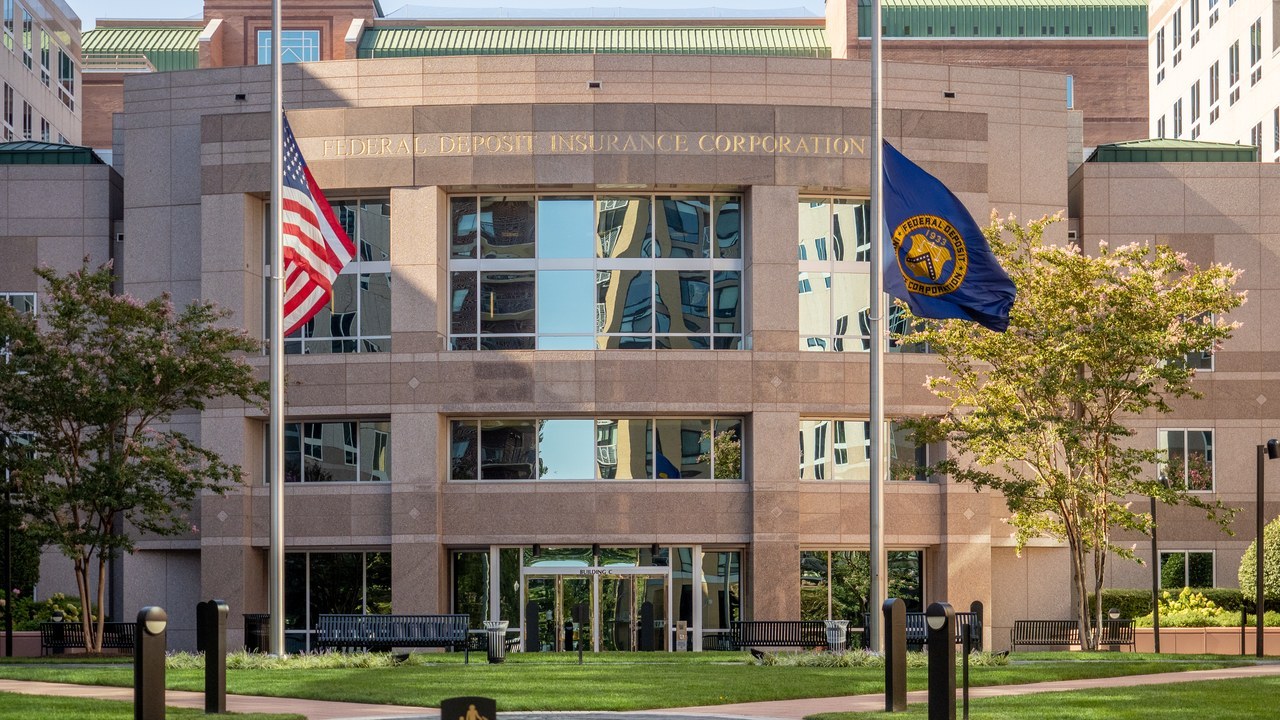
Nano Banc, a one-branch bank in Irvine, California, was closed on September 25, 2026, and Sunwest Bank agreed to assume substantially all of its deposits. The bank held $686 million in deposits and $736 million in assets as of June 30, 2026. The Federal Deposit Insurance Corporation was named receiver, and its announcement says Nano Banc’s depositors automatically became Sunwest Bank depositors.
What the FDIC said happened to Nano Banc on September 25
The California Department of Financial Protection and Innovation closed the bank and appointed the FDIC as receiver, according to the FDIC’s September 25 press release. The release is titled “Sunwest Bank Assumes All Deposits and Certain Assets of Nano Banc, Irvine, California,” and its operative sentence is narrower than the headline: “Sunwest Bank agreed to assume substantially all deposits at the time of closing.”
That wording matters for the arithmetic. The $686 million figure is the bank’s total deposits as of June 30, a date nearly three months before the closing. The bulletin does not state how many dollars Sunwest took on at the moment of closing, so the safest reading is the one the FDIC gives: substantially all of the deposits moved, and the June 30 total is the benchmark for the size of that transfer.
Sunwest Bank took over the Irvine branch and a slice of the assets
Sunwest Bank, based in Sandy, Utah, bought approximately $476 million of Nano Banc’s $736 million in assets. The bank’s only branch reopened as a Sunwest Bank branch on Monday, September 28, during normal business hours.
The weekend gap between Friday’s closing and Monday’s reopening was bridged with ordinary payment tools. According to the release, customers could reach their deposits over the weekend by writing checks or using ATM or debit cards. The FDIC listed a customer hotline, 1-866-314-1744, with extended hours through Monday and weekday hours of 8 a.m. to 4 p.m. Pacific time afterward. The release says deposits assumed by Sunwest continue to be protected by FDIC insurance, and that no customer action is needed.
The $114 million estimated cost to the Deposit Insurance Fund
The FDIC’s preliminary estimate is that the failure will cost the Deposit Insurance Fund $114 million. That is the FDIC’s estimate of what the failure will cost the insurance fund, not a loss to depositors, and the bulletin labels it preliminary, so the final number may differ.
The bulletin pairs the estimate with the bank’s June 30 totals of $736 million in assets and $686 million in deposits, and says Sunwest purchased roughly $476 million of those assets.
A capital shortfall regulators had flagged for years
The FDIC release describes what happened but not the reasons. Banking Dive, citing California regulators, reported that Nano Banc’s shareholder equity had fallen below the 3 percent statutory minimum and that the state labeled the bank in an “unsafe and unsound” condition. In March 2026, the California Department of Financial Protection and Innovation had ordered the bank to raise its tangible shareholders’ equity ratio to at least 9.5 percent or pursue voluntary liquidation, merger or sale. The department said Nano Banc “failed to successfully take any of the available actions,” according to that report.
The same account traces supervisory problems back to 2020, when California regulators identified significant risk-management weaknesses and violations of law, and notes that the bank reported a net loss of $75.3 million before the March order. Banking Dive counted the closing as the sixth U.S. bank failure of 2026, a tally the FDIC’s own failed-bank list could not confirm because that page was not accessible when this story was checked.
Two sets of numbers that do not match the FDIC’s
Banking Dive’s figures differ from the FDIC’s in places. It reports roughly $605 million in deposits assumed by Sunwest, compared with the FDIC’s $686 million in total deposits, and it cites about $690 million in assets from the California regulator against the FDIC’s $736 million. The two sets of figures may reflect different dates or definitions, and the FDIC bulletin is the only one of these documents that states its own measurement date, June 30, 2026. This story therefore uses the FDIC’s totals and treats the $605 million as a separate, unreconciled report.
Sunwest’s chief executive, Carson Lappetito, was quoted by Banking Dive saying the acquisition “reflects the financial strength, disciplined management, and stability that have defined Sunwest Bank for more than five decades.” The statement describes the buyer, not the condition of any depositor’s account.
What the $250,000 insurance limit means in a transfer like this
The FDIC’s deposit insurance page sets the standard maximum at $250,000 per depositor, per FDIC-insured bank, for each account ownership category. The same page says the FDIC acts quickly when a bank closes so that access to insured deposits is not interrupted, and that no depositor has lost a penny of FDIC-insured funds since the agency’s founding in 1933.
In the Nano Banc case, the sequence that the FDIC describes is the lighter one: a purchaser assumed the deposits, the branch reopened under a new name, and the bulletin directs no step from customers. The agency’s own release is the controlling record for the closing date, the receivership, the acquirer, the $686 million deposit total and the $114 million cost estimate.
When an account changes banks without moving a dollar
Nano Banc depositors became Sunwest Bank depositors without filing anything, which the FDIC says required no customer action. The gap that remains after a transfer like that is record-keeping, since statements, account details and any open disputes now sit with a different institution.
The Bank Account & Debt Protection Kit includes the 2-month bank protection rule, the frozen-account response and a protected-funds and dispute log for keeping those records in one place.
Open The Bank Account & Debt Protection Kit to log an account that changed hands →
This piece was drafted with AI assistance; the figures were checked against the FDIC’s September 25 bulletin and deposit insurance page, with the regulatory background attributed to Banking Dive.


