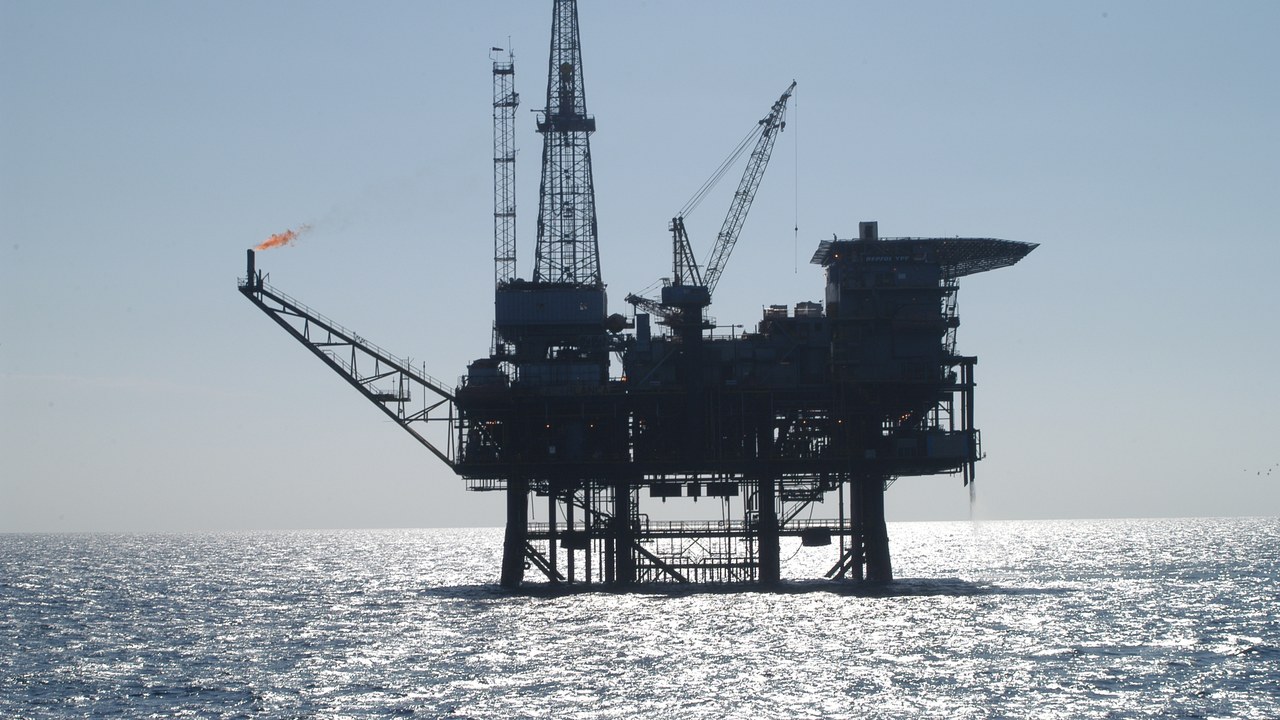
The first hurricane of the 2026 Atlantic season has emptied a large part of the Gulf of Mexico’s oil patch. As of Oct. 8, about 1.3 million barrels a day of crude production were shut in and crews had been pulled off 130 production platforms and rigs, according to the U.S. Energy Information Administration, the Energy Department’s statistics arm. Its Oct. 9 report says Hurricane Isaias was nearing landfall.
The count from the offshore regulator
The federal agency that oversees offshore drilling safety publishes its own tally. In a release dated Oct. 8, it said that as of 11 a.m. Central that day, 12 companies had reported shutting in 1,282,879 barrels a day of oil, about 62.89 percent of the Gulf’s current daily oil production. Gas shut-ins stood at 1,127 million cubic feet a day, or 57.35 percent.
The same release counts the people moved out of the way. Personnel had been evacuated from 121 production platforms, 32.61 percent of the 371 manned platforms in the Gulf. On drilling rigs, 5 of the 11 rigs that are not dynamically positioned had been evacuated, 45.45 percent. Four of the 17 dynamically positioned rigs, which hold their place with thrusters, had moved off location, with personnel still aboard.
A storm with few recent matches
EIA describes Isaias as the largest storm expected to hit the region since Hurricane Helene in September 2024. At 4 a.m. Central on Oct. 9, the National Oceanic and Atmospheric Administration expected landfall on the Gulf Coast late Friday or early Saturday, and EIA flagged the potential for significant disruption to energy infrastructure.
What the reports do not say is how long the wells will stay closed. The regulator has not announced a restart schedule, and EIA’s report does not give one either.
For a driver who fills up every week, the question is whether a storm in the Gulf will show up at the pump, and when.
Gulf crude is 1.3 million barrels a day short, and regular gasoline already costs $4.37 a gallon nationally, so a household that drives pays attention to every move. The Benefits Checklist covers 11 benefit programs and the 2026 income limits for help with the costs that rise when fuel does.
Find the 2026 income limits for 11 programs in The Benefits Checklist →
What drivers pay right now
AAA’s national average for regular was $4.3718 on Oct. 9, up from $4.2245 a month earlier and $3.1106 a year earlier. Diesel averaged $6.2785. Regular was down 2.4 cents from a week earlier and up about a penny from the day before.
The Gulf Coast was the cheapest region for gasoline in EIA’s survey for the week of Oct. 5, at $3.911 a gallon. That region is also where the storm is headed, so it will be the first place to show any change in the weekly survey, which EIA next posts on Oct. 14.
Neither agency has put a number on what Isaias will add to the pump price, and the amount depends on how long production stays offline and whether refineries and pipelines take damage. The reports carry no word yet on either.
Oil prices were already high
The storm hit a market that was already tight. In its outlook released Oct. 6, EIA raised its fourth-quarter Brent forecast to $105 a barrel, $14 higher than a month earlier, on the assumption that Middle East flows stay constrained. That forecast was completed Oct. 1, before the storm’s shut-ins began, so a fresh estimate will show up in the next monthly outlook.
Who is counting
The agency, now called the Marine Minerals Administration after the Bureau of Ocean Energy Management and the Bureau of Safety and Environmental Enforcement were reunified on July 10, 2026, says it updates the numbers daily at 1 p.m. Central.
The Gulf of Mexico is where much of the country’s offshore oil and gas comes from, which is why shut-ins draw attention. A shut-in is a precaution that stops production ahead of a storm, not a measure of damage.
Watching for pump-price changes
The quickest signals are free. AAA posts its national and state averages every day, and EIA posts a weekly survey. A reading that rises several days in a row, not a one-day blip, is what would point to the storm.
Households that put off a fill-up can think through what an extra 10 or 20 cents a gallon means. On a 12-gallon tank, 10 cents is $1.20 and 20 cents is $2.40, and over four weekly fill-ups the totals are $4.80 and $9.60. Those are small numbers next to a grocery bill, but they land every week.
The regulator’s daily updates and EIA’s reports are where any news on restarts will appear first.
A storm that shut in 1.3 million barrels a day
If Isaias raises pump prices, the added cost falls on the same monthly income that covers food, medicine and heat. The Benefits Checklist is an 84-page guide to 11 benefit programs, with the 2026 income limits and a 50-state phone directory, so help that must be applied for gets requested.
Get The Benefits Checklist with 11 programs before fuel costs climb →
This article was produced with AI assistance and edited for accuracy against the sources linked above.