
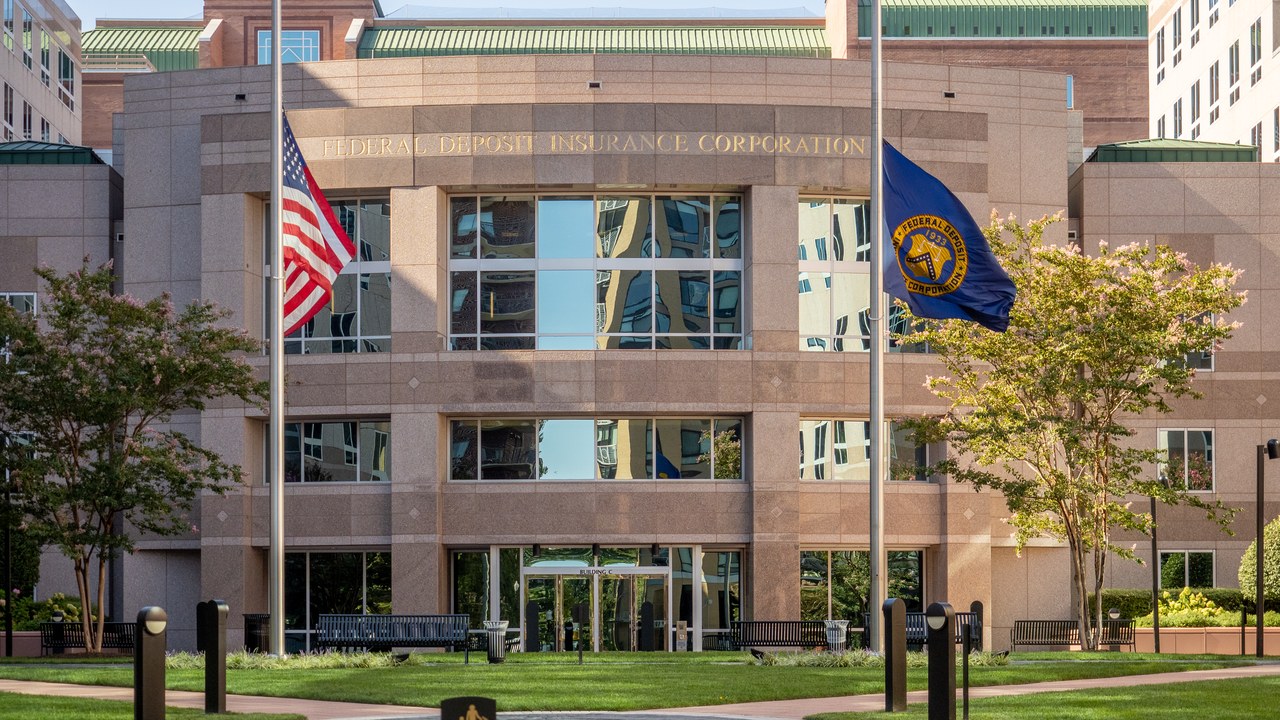
Old Glory Bank, based in Elmore City, Oklahoma, is operating under an FDIC order. The bank reported $268.7 million in deposits and $7.5 million in Tier 1 capital on its June 30, 2026 call report. It remains open, and its deposits stay covered by FDIC insurance up to the standard $250,000 limit.
A supervisory directive, not a failure
The FDIC’s Sept. 25 bulletin of enforcement orders for August 2026 lists the action against the bank as a “Supervisory Prompt Corrective Action Directive.” Prompt corrective action is the framework regulators use when a bank’s capital falls below set levels; it directs the bank to change how it operates while it repairs its capital. It is not a closure.
Banking Dive reported that the directive was dated Aug. 28, 2026 and that it places Old Glory in the “significantly undercapitalized” category, the fourth of five capital levels. The Banking Dive report also states that the bank is open and its deposits are insured. In the same article a bank spokesperson said, “We are raising capital from our great ownership group.”
What the June 30 call-report figures say
The two numbers come from the FDIC’s financial data for the quarter ended June 30, 2026, which is the bank’s call report as published through the agency’s data service. Deposits were $268,655 thousand, or $268.7 million. Tier 1 capital was $7,467 thousand, or $7.5 million. Total equity capital was a little lower, at $6,782 thousand, or $6.8 million.
Total assets were $276,783 thousand, or $276.8 million, and the bank lost $7,993 thousand, about $8.0 million, in the first half of the year. Its Tier 1 leverage ratio was 2.69%. Set beside each other, Tier 1 capital of $7,467 thousand equals about 2.8% of $268,655 thousand in deposits, the gap the headline figures describe. Every figure in this section is a snapshot of a single quarter-end date, June 30, 2026, and none describes the bank on any day since.
Restrictions the directive imposes
According to Banking Dive, the directive requires Old Glory to submit an updated capital restoration plan within two weeks and to stop capital distributions or management-fee payments that would worsen its capital. The bank may not accept brokered deposits or employee benefit deposits until it is adequately capitalized, and its deposit interest rates are restricted. It needs FDIC approval before paying bonuses or added pay to senior executives, must reduce or end activities regulators judge too risky, and must send the FDIC monthly written compliance reports.
American Banker separately described the leverage ratio of 2.69% as below the 4% minimum for an adequately capitalized bank, and reported that the order lets regulators require the bank to raise capital, seek an acquirer or, potentially, liquidate. Those are powers the order gives regulators; neither report says any of them has been used.
The directive stays in force until the bank holds adequate capital for four consecutive quarters. Chief executive Mike Ring told American Banker, “We are currently raising the capital we need to return to being adequately capitalized.”
What the restrictions mean for customers day to day
Several of the limits are aimed at how the bank funds itself rather than at customers’ accounts. A ban on new brokered and employee benefit deposits, a cap on the rates it can pay and a requirement to clear executive pay with the FDIC all shape the bank’s balance sheet. Nothing in the reports describes a restriction on customers withdrawing funds or using their accounts, and the bank remains an FDIC-insured institution.
An older order and a much higher capital target
The new directive follows a consent order the FDIC issued to Old Glory on May 1, 2024. The consent order requires the bank to maintain a Tier 1 leverage ratio of 14% of average total assets and to submit progress reports each quarter, and it bars dividends or bonuses without regulators’ prior written consent. Against that 14% target, the June 30 ratio of 2.69% leaves a wide gap. Banking Dive reports the bank lost about $8 million in the first half of 2026 and that a planned merger with a special-purpose acquisition company was dropped in August after the Federal Reserve declined approval.
What FDIC insurance covers at any insured bank
Deposit insurance is a separate matter from capital levels. The FDIC’s deposit insurance page says it insures deposits to “$250,000 per depositor, per ownership category at each FDIC-insured bank,” and that “since the FDIC was founded in 1933, no depositor has lost a penny of FDIC-insured funds.” A balance at or below $250,000 in one ownership category at one insured bank sits entirely inside the standard limit, while any amount above it in that category falls outside it. The agency’s Electronic Deposit Insurance Estimator, known as EDIE, lets depositors work out how much of their funds is covered.
The primary record for the order is the FDIC’s own enforcement-orders listing, which names the directive; the capital and deposit figures rest on the June 30, 2026 call report, and the FDIC’s insurance page sets the $250,000 limit that applies to every insured bank.
For households with a bank account under creditor pressure
Households whose bank accounts are frozen or garnished by a creditor have to sort out which money is protected. Those rules are general ones and are separate from any one bank’s regulatory status.
The Bank Account & Debt Protection Kit is a 10-page kit covering the 2-month bank protection rule and the frozen-account response, with a protected-funds and dispute log for recording what happened.
Log protected funds and account disputes in one place →
This article was prepared with AI assistance and checked against FDIC records and the news reports linked above.


