
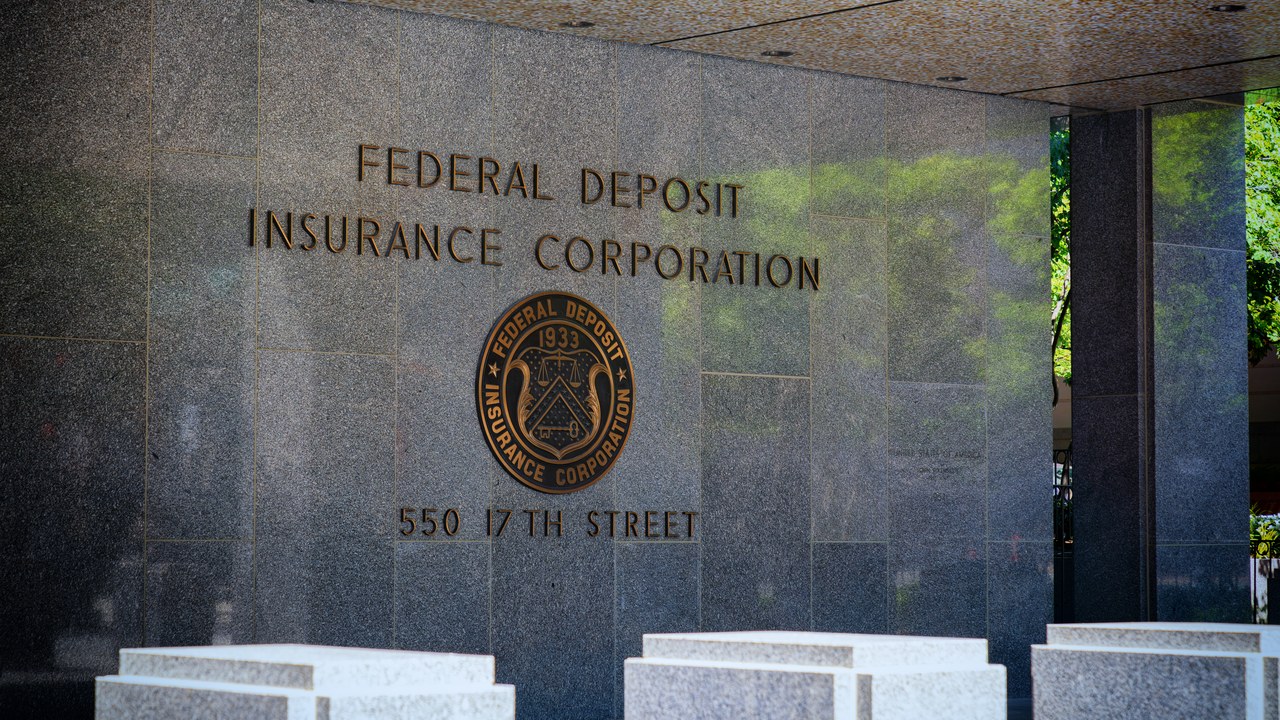
Bank money market accounts pay an average of 0.63%, according to the national rate series built from FDIC data. Money market funds, a different product with a similar name, are yielding about 3.65% on Crane Data’s index of 100 large funds. The gap is 3.02 percentage points, and the fund side comes with a disclosure the bank side does not: money market funds are not guaranteed by the FDIC.
One name, two kinds of product
A money market deposit account is a bank product. A money market fund is a mutual fund that invests in short-term debt and is sold through brokerages and fund companies. The overlap in names causes routine confusion, and the yields quoted for each are not measuring the same thing. The bank figure is an interest rate on a deposit. The fund figure is a seven-day yield on shares whose value can, in principle, move.
What Crane Data’s 3.65% measures
Crane Data’s home page reports the Crane 100 Money Fund Index seven-day yield at 3.65% as of Sept. 27, up 0.01 from the prior reading. The same page notes that money market fund assets rose to $8.44 trillion in August. That figure is an index of large funds, so an individual fund can sit above or below it.
Schwab publishes its own numbers on its money fund yields page, which shows seven-day yields as of Sept. 25. The Schwab Prime Advantage Money Fund’s Investor Shares (SWVXX) were at 3.70%. A government fund, SNVXX, was at 3.57%. The Schwab sweep fund SWGXX was at 3.47%. The spread among those three is 0.23 percentage point, a reminder that the fund a brokerage account defaults to may pay less than the best fund in its own lineup.
The bank side: 0.63% and 0.37%
The St. Louis Fed’s FRED database carries the national money market deposit rate at 0.63% for September 2026, and its savings series puts the national savings rate at 0.37%. These are averages across banks. A bank with a promotional rate can pay well above them.
The arithmetic is direct for a $10,000 balance held for a year at a constant yield. At 0.63%, that is $63 of interest. At 3.65%, it is $365. The difference of $302 is simple interest and ignores compounding and any change in fund yields, which reset as the securities in a fund mature and are replaced.
What FDIC insurance covers and money funds lack
The Securities and Exchange Commission’s Investor.gov bulletin on money market funds states that “money invested in a money market fund, like money invested in any mutual fund, is not guaranteed by the FDIC.” The same bulletin warns of “a risk you may lose some or all of the money you invested.” It contrasts funds with bank deposit accounts, which receive FDIC protection “up to certain limits.”
That distinction is the practical reason for the yield gap. Deposits at an insured bank carry federal protection up to a limit, so banks can pay little and still attract balances. A fund pays more and offers no such backstop. The bulletin also tells investors to consider fees, which reduce what a fund’s stated yield delivers.
What the comparison does and does not show
The comparison shows two published averages measured on different products. It does not show that any fund is a better home for emergency savings, and it does not predict where either number will be next month. Fund yields follow short-term interest rates and can fall as easily as they have risen.
The Federal Reserve raised its target range to 3-3/4 to 4 percent on Sept. 16. Money funds hold short-term securities, so their yields sit close to that range. A bank money market account averaging 0.63% is far below it.
Where the sweep default enters
Many brokerage accounts park uninvested cash in a default fund, and the Schwab page shows how much the choice of fund can matter inside one lineup. On $10,000 held for a year, the 3.47% sweep fund yields $347 and the 3.70% Investor Shares fund yields $370, a $23 difference on identical balances. Both are far above the 0.63% bank average, and both are subject to the same disclosure: neither is guaranteed by the FDIC.
A bank account is the more familiar place to hold cash, and its protection is the reason many households accept a lower rate. Each household weighs that trade-off differently, and the published averages are the starting point, not the answer.
The record behind the numbers
The three published sources are Crane Data’s index reading of 3.65% as of Sept. 27, the FRED series reporting a 0.63% national money market deposit rate for September, and the SEC’s plain statement that a fund’s money is not guaranteed by the FDIC. Schwab’s page supplies fund-level examples, from 3.47% to 3.70%, as of Sept. 25.
Planning which retirement account pays the bills
The planner is written for retirees and people nearing retirement who hold savings in several kinds of accounts and want to see how taxes shape what is left to spend. It addresses the problem that Social Security taxation, required distributions and Medicare surcharges each follow their own rules, and the rules interact.
The Retirement Tax & Withdrawal Planner is a 12-page planner with four calculators, including provisional income and the RMD schedule, along with the account withdrawal order.
Get the account withdrawal order in The Retirement Tax & Withdrawal Planner →
Drafted with help from an AI assistant, this article was checked against Crane Data, Schwab, FRED and SEC pages listed above.


