
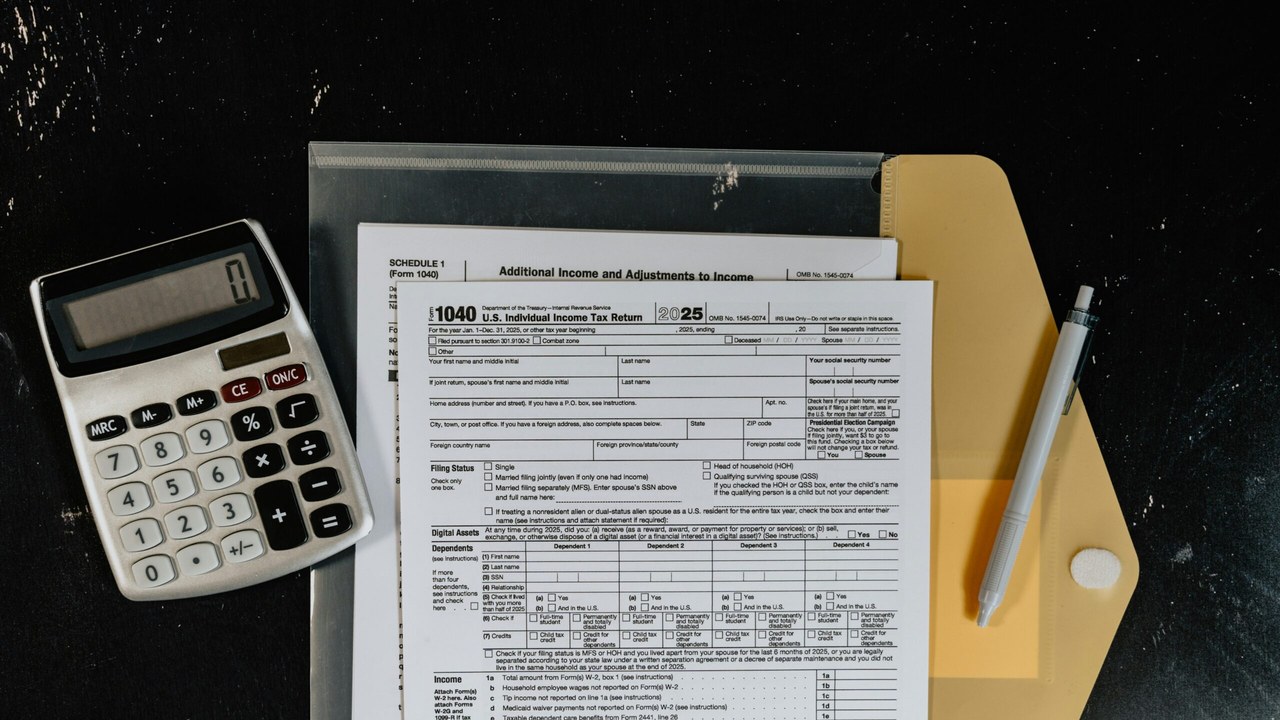
The One, Big, Beautiful Bill created four new individual deductions for the 2025 tax year: no tax on tips, no tax on overtime, a car loan interest deduction, and an enhanced deduction for people age 65 and older. All four now run through a single new IRS form, and a return that claims any of them without that form attached has not actually substantiated the deduction it is claiming. That form is Schedule 1-A, Additional Deductions, and it attaches to Form 1040, 1040-SR or 1040-NR.
How Schedule 1-A Calculates the Four New Deductions
Schedule 1-A did not exist before this filing season. The IRS built it specifically to calculate and total the four new deductions in one place, and it is available now as a released form for 2025 returns, not a draft still under review — the released PDF is labeled 2025 and carries no draft watermark. The schedule works in six parts. Part I establishes a taxpayer’s modified adjusted gross income, the figure every deduction’s phase-out depends on. Parts II through V calculate the tip, overtime, car-loan-interest, and senior deductions one at a time, each with its own income ceiling and its own eligibility checks — a valid Social Security number, a joint return for married filers, and, for the car-loan deduction, a vehicle identification number tied to a loan taken out after December 31, 2024. Part VI adds the four results together, and that single combined figure, not each deduction counted separately, is what gets carried to line 13b of Form 1040. The released version also carries the technical markers of a finalized IRS form rather than a preview: an OMB control number, a Paperwork Reduction Act notice, a printed catalog number, and Attachment Sequence No. 1A, the number the IRS uses to file it in order alongside a return. The IRS’s own guidance is explicit that eligible taxpayers can use the schedule whether they itemize or claim the standard deduction, which matters because most households claiming these four deductions are not itemizers at all.
Free download: What each refund-status message means, the direct-deposit and paper-check paths, and when to follow up with the IRS. Get the free refund delay decision tree.
The Income Math That Requires the Extra Form
None of the four deductions is a flat number a taxpayer can simply drop onto a return. Each phases out on its own schedule tied to modified adjusted gross income: the tip and overtime deductions begin phasing out above $150,000 of income for a single filer or $300,000 for a married couple filing jointly, the car-loan-interest deduction phases out above $100,000 or $200,000, and the senior deduction phases out above $75,000 or $150,000, according to the IRS’s Working Families Tax Cuts summary, last reviewed in late August 2026. Running that math is exactly what Schedule 1-A’s worksheets do — dividing income over the threshold, multiplying by a set rate, and subtracting the result from the maximum deduction. A taxpayer near a phase-out line who simply writes a number on line 13b without working through those steps has no way to know whether the figure is even correct, and the IRS has no attached calculation behind the entry to check it against.
Who Skips the Schedule and Why
The filers most likely to miss Schedule 1-A are the ones who assume a deduction tied to the standard deduction needs no extra paperwork. Seniors claiming the enhanced deduction often fall into that trap, since the added amount layers on top of the regular senior standard deduction rather than requiring itemizing. Workers whose tips arrive on a 1099 rather than a W-2 face a similar gap: the schedule reports tip income differently depending on whether it came through an employer, self-employment, or Form 4137, and a filer who only recognizes the W-2 boxes may not realize a separate section applies to them. Car-loan-interest claimants can trip on the origination-date and lien rules built into Part IV, since a loan taken out before 2025, or interest on a leased vehicle, does not qualify no matter how it appears on a lender’s statement. Extension filers still finishing 2025 returns this fall carry the same exposure as anyone who filed in the spring — the schedule is required regardless of when in the year the return goes in, and a return that reaches the IRS without it is incomplete for any of the four deductions it claims.
What Comes Back Instead of a Refund
When Schedule 1-A is missing or its figures do not line up with the rest of a return, the IRS does not simply approve the deduction and move on. Processing typically pauses while the agency checks the missing calculation, and the taxpayer’s first real signal that something is wrong is often a delay or a notice rather than a plain explanation of what happened. Working out which notice applies, and what step comes next, is where many filers get stuck.
The IRS Refund Recovery Kit walks through a notice decoder for making sense of an IRS letter and lays out the refund-trace steps built around Form 3911 for a return that has stalled.
Look up the 3-year refund deadline in The IRS Refund Recovery Kit.
AI-assisted research and drafting; reviewed by an editor.


