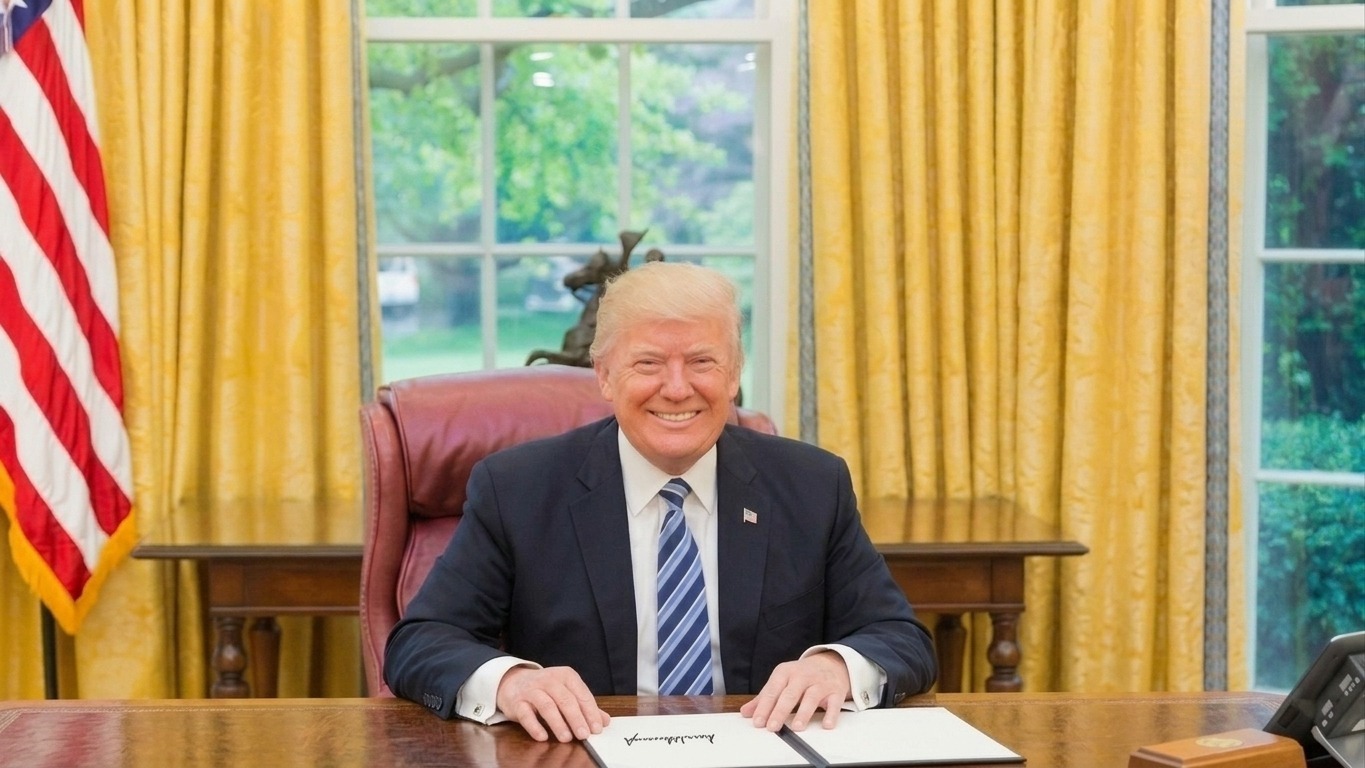
A new executive order signed this week puts foreign-made equipment inside America’s power grid under direct federal scrutiny, but it stops well short of reaching the wires and transformers that actually carry electricity into most homes. President Trump signed Executive Order 14420 on August 26, declaring a national emergency over the bulk-power system, the high-voltage backbone that moves electricity across states and regions. Households will not see this order touch their neighborhood power lines, and the text says so directly.
What the National Emergency Actually Declares
The order invokes the International Emergency Economic Powers Act and the National Emergencies Act to address what the White House calls foreign exploitation of vulnerabilities in bulk-power system equipment, including transformers, generators, protective relays and grid-connected control systems built abroad. It generally prohibits acquiring, importing or installing certain foreign-produced equipment tied to a “Covered Foreign Entity,” or requires it to be cleared through conditions set by the Secretary of Energy, when that equipment poses risks of sabotage, unauthorized remote access, or catastrophic disruption to the grid. The order directs the Energy Department to publish rules operationalizing those restrictions within 120 days, meaning the specific equipment list and licensing process are not yet public. Reporting on the order’s text confirms the equipment it names explicitly includes transformers, batteries, inverters and associated software and digital products, and that it also lets the Energy Secretary impose conditions on equipment already installed before August 26, including its continued use, servicing or updating.
Free retirement updates: One number can cost or save hundreds a month in retirement. The free Retirement Shield newsletter surfaces the ones worth knowing. Sign up free.
The Local-Delivery-Lines Exemption, in the Order’s Own Words
The headline’s most important detail is not spin from either side; it is written directly into the order’s definitions section. Executive Order 14420 defines the “bulk-power system” it covers as transmission facilities rated at 69,000 volts or higher, then states plainly that the definition “does not include facilities used in the local distribution of electric energy.” That is the equipment that carries power from a substation to a house, a bank branch or a corner grocery store. The companion White House fact sheet repeats the same carve-out in plain language, confirming the exemption is not an accident of drafting.
Why the Line Between Bulk-Power and Local Distribution Matters
That distinction determines who is actually affected. Bulk-power equipment sits in transmission substations and large generating stations, purchased and maintained by utilities, regional grid operators and large industrial customers, not by homeowners. Local distribution lines and transformers, the equipment that steps voltage down and runs it to a house, a strip mall or a rural co-op member, are the pieces this order explicitly does not touch. A homeowner replacing a service line, a small business swapping out a rooftop transformer, or a municipal utility buying distribution-grade equipment falls outside this order’s prohibitions, no matter where that equipment was manufactured.
Built on a 2020 Order, and What Utilities Are Saying Now
This is not the first time Washington has tried to wall off foreign equipment from the grid. Utility Dive’s reporting on the new order traces it back to Executive Order 13920, a similar national-emergency declaration Trump signed in May 2020 that focused mainly on large power transformers linked to China. The Biden administration suspended that 2020 order for 90 days in January 2021, and the Energy Department later revoked the specific prohibition it had issued under it. A National Electrical Manufacturers Association official told Utility Dive the new order “builds off” the 2020 version and functions as “kind of an update and expansion,” now explicitly reaching inverters, battery storage systems and the software that runs them, categories barely part of the grid conversation in 2020.
The Edison Electric Institute, which represents investor-owned utilities, told Utility Dive it is “committed to working with DOE on the implementation of this order to ensure that we can maintain the reliability and affordability of electricity across the country,” a direct acknowledgment that implementation choices could touch what utilities pay for equipment and, eventually, what shows up in rate cases. Manufacturers flagged a specific point of confusion: determining the country of origin for embedded software and digital components is harder than for physical hardware, and the order does not name specific countries, leaving that determination to the forthcoming DOE rules. The stakes are real for equipment sourcing broadly: citing the International Energy Agency, Utility Dive reported that China accounts for roughly 80 percent or more of global production of certain grid equipment, including lithium-ion battery cells and some solar components, which is the underlying supply-chain concentration this order is aimed at reducing.
What Remains Unsettled
The order authorizes the Energy Secretary, working with other Cabinet officials, to identify specific at-risk equipment and to impose conditions on gear already installed before August 26, including requirements to isolate, monitor or eventually replace it, but only after weighing effects on reliability, safety and continuity of service. None of that equipment list exists yet in public form. The order also directs a Federal Acquisition Regulation review within 180 days aimed at steering federal energy-infrastructure purchases toward domestic manufacturers. Households will not feel the mechanics of this order directly; the price and reliability effects, if any, would show up gradually through what utilities pay for transmission-grade equipment, not through a local meter or delivery line.
How This Fits the Administration’s Broader Grid Actions
This is not the administration’s first move on grid security. The White House fact sheet points back to an April 2025 order aimed at keeping existing power plants online amid what it described as burdensome state and federal environmental rules, plus a string of 2026 actions on AI-related infrastructure and defense supply chains. Framed together, the pattern is aimed at the equipment and generation side of the grid, the transmission lines, transformers and power plants that keep the system running at scale, rather than at the delivery infrastructure that determines what shows up on a household’s monthly electric bill.
This article was produced with AI assistance and reviewed by a human editor. Figures are linked to their primary sources; where a claim could not be verified from the public record, we say so.
More Financial Reading