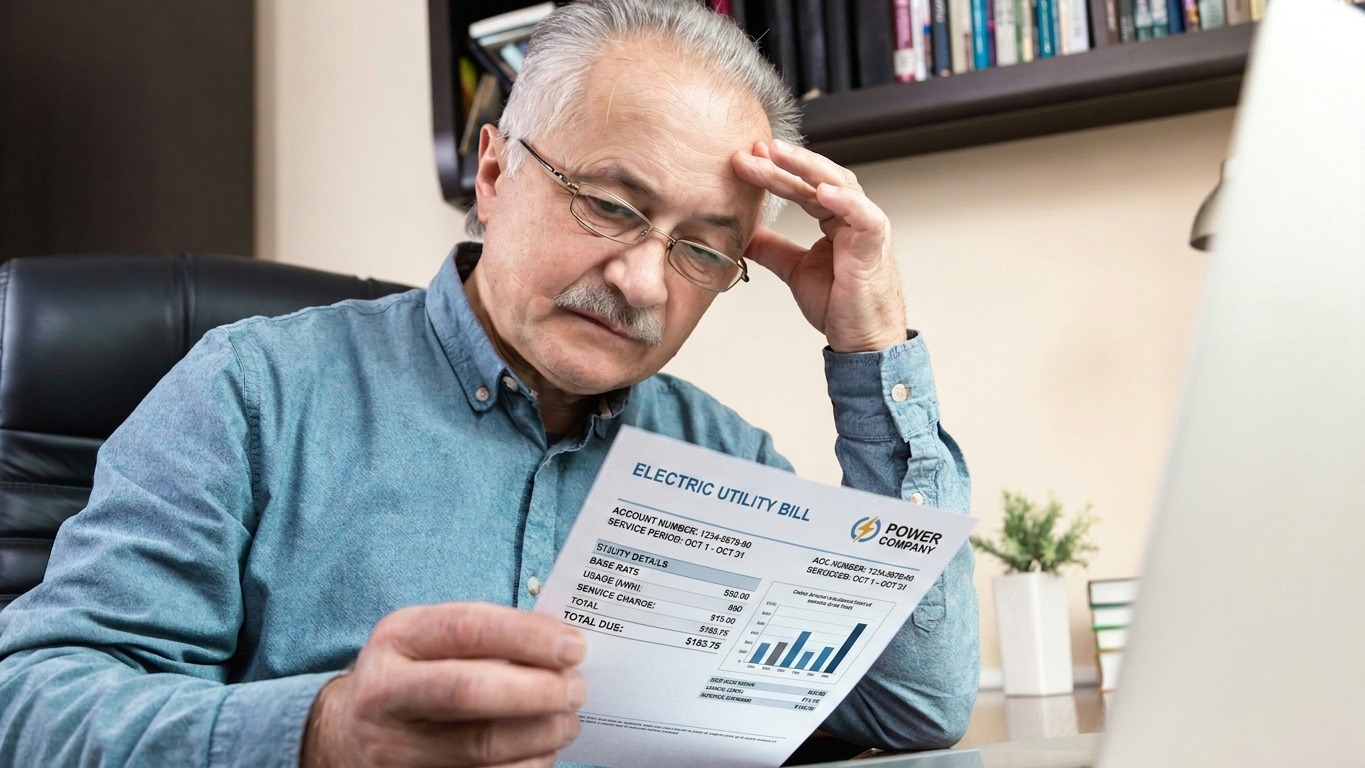
Eighteen point three cents per kilowatthour means nothing until it is multiplied by a month of ordinary use. The Energy Information Administration’s most recent published figure puts the average U.S. residential customer at roughly 899 kilowatthours a month, which turns that rate into about $165 of electricity before taxes, fees and the fixed monthly charge most utilities add on top. At last year’s average of 17.3 cents, the same month of power ran closer to $156.
Nine dollars a month is the shape of the change, and it is worth being exact about what kind of number produces it. The 18.3-cent figure is not a measurement of what households paid this year. It is a projection of where the full-year average will land, published while five months of the year are still unrecorded.
What 18.3 cents costs on an average month of household use
EIA’s own consumer figures give the multiplication some grounding. Its published estimate, based on 2022 sales data and still the agency’s current answer, is that the average residential electric-utility customer buys 10,791 kilowatthours a year, about 899 a month. Run a full year at 18.3 cents and that is roughly $1,974 of electricity, against about $1,866 at last year’s 17.3 cents, a difference of a little over $100 across the year.
The averages hide enormous spread, and EIA is explicit about the range. In that same dataset, Louisiana households bought the most electricity in the country at 14,774 kilowatthours a year, and Hawaii households the least at 6,178. A rate change of one cent moves the Louisiana household’s annual bill by nearly $148 and the Hawaii household’s by about $62, before either one’s local rate is taken into account.
Free retirement updates: Household bills rarely rise in isolation. The free Retirement Shield newsletter connects the changes that matter to working families and retirees. Read it free.
Two of these four numbers are history and two are forecasts
The figure comes from the July 2026 Short-Term Energy Outlook, the monthly forecast EIA publishes for energy prices and supply. Its electricity section carries the residential price as a four-year series: 16.5 cents per kilowatthour in 2024, 17.3 cents in 2025, 18.3 cents projected for 2026 and 18.7 cents projected for 2027.
The first two entries are settled history. The second two are labeled projected, and the distinction is not decorative. Moving from 17.3 to 18.3 cents is a rise of about 5.8 percent, and it is a rise EIA expects rather than one it has measured. The 2027 figure implies a much smaller further step of roughly 2 percent, which is itself a forecast built on top of a forecast.
This edition of the report was released on July 7, 2026, with the forecast completed on July 1, and the next edition is scheduled for August 11. Each monthly edition revises the annual averages as real data arrives, which is precisely why 18.3 cents is best read as a projected annual average still in motion rather than as a settled price.
Wholesale power is forecast to get cheaper while the household rate climbs
The same report contains what looks at first like a contradiction. EIA forecasts that wholesale electricity prices this summer will run about $4 per megawatthour below last summer, averaging around $45, mainly because natural gas delivered to power plants is cheaper. Some regional declines in the forecast are steep: the Northwest’s Mid-Columbia hub falls 46 percent to $27 per megawatthour, California falls 30 percent to $23, the Southwest falls 27 percent to $28, and the Midcontinent ISO region falls 18 percent, from $56 last summer to $46.
Households do not buy electricity at wholesale. A residential rate bundles the cost of generating power with the cost of moving it, and the transmission and distribution portion is set through state regulatory proceedings that move on their own timetable. A cheaper summer for power plants and a more expensive year for residential customers can sit in the same report without either being wrong.
Volume is the other half of the picture, and it is pointing up. The same report’s summary table puts total U.S. electricity generation at 4,309 billion kilowatthours in 2024 and 4,430 in 2025, with 4,502 projected for 2026 and 4,636 for 2027. Cheaper fuel is meeting a larger load, and the generation mix EIA forecasts for this year is 40 percent natural gas, 18 percent nuclear, 15 percent coal and 8 percent solar. None of that reaches a household bill directly, but it is the machinery the 18.3-cent forecast is built from.
When a measured 2026 average will actually exist
Actual prices are published as they are collected. EIA reports measured retail electricity prices each month in its Electric Power Monthly, and a genuine 2026 annual average cannot be calculated until every month of the year has been reported, which pushes it well into 2027. Until then, the 18.3-cent figure will be revised monthly.
The other number households will want does not exist yet either. EIA’s estimates of what a winter’s heating will cost come from a separate publication, and the July report states its release date directly: the Winter Fuels Outlook publishes on Wednesday, October 15. Anything presented before then as this winter’s heating bill forecast is not coming from EIA.
This article was produced with AI assistance and reviewed by a human editor. Figures are linked to their primary sources; where a claim could not be verified from the public record, we say so.
More Financial Reading