
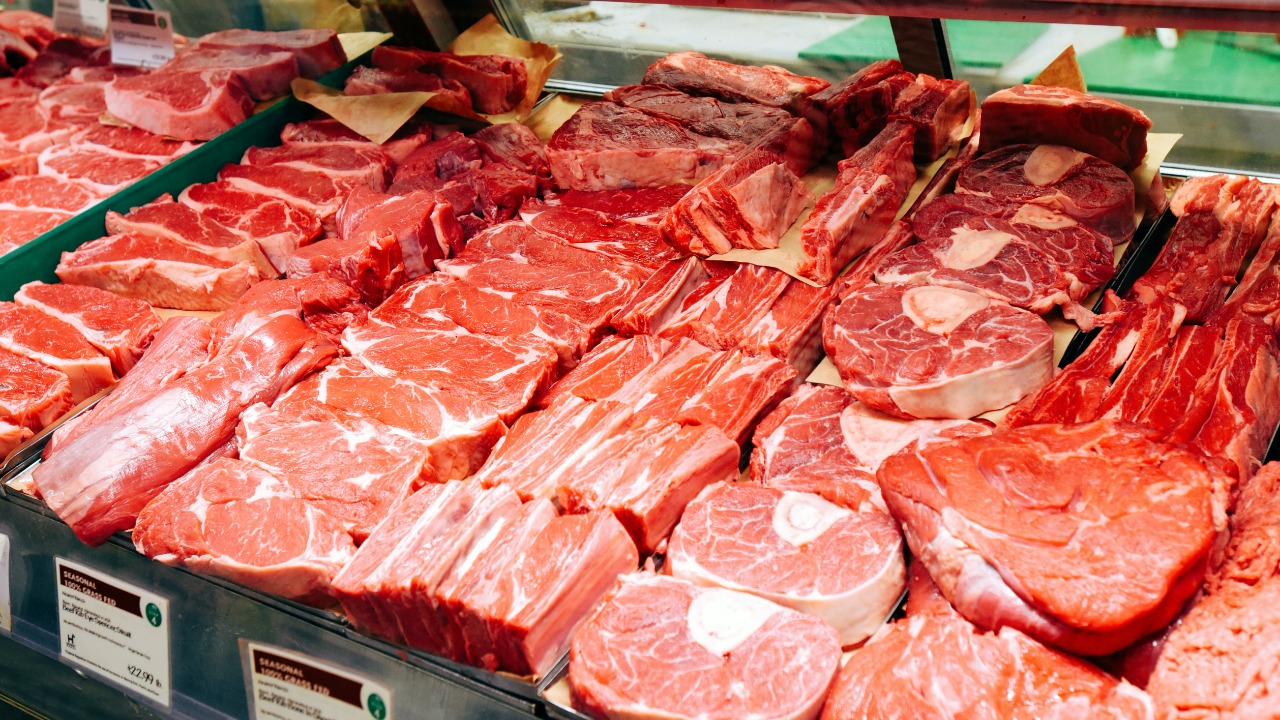
In its latest Food Price Outlook, released Sept. 25, USDA’s Economic Research Service forecasts supermarket beef and egg prices moving in opposite directions this year. Beef and veal are projected to average 9.4% higher in 2026 than in 2025, while egg prices are expected to fall 29.4% over the same period. The swing reflects a smaller cattle herd pushing beef higher and an egg supply still recovering from years of bird flu.
USDA’s 2026 food-price forecast: It says nothing about the property-tax bill or heating cost rising alongside the grocery total, a gap The Senior Property Tax & Home-Cost Relief Kit walks through. Weigh the beef-price squeeze against five kinds of property-tax relief →
A Cattle Herd Running About 2% Smaller
USDA’s Economic Research Service attributes the higher beef forecast mainly to tighter supply: federally inspected beef production has run about 2% lower over the past year, according to the agency’s September Food Price Outlook. The report puts the 2026 beef and veal increase at 9.4%, with a forecast range of 7.4% to 11.6% that accounts for how much supply could still shift before the year closes out. Cattle supply moves on a long lag: it takes roughly two years to raise a calf to slaughter weight, so today’s tighter herd traces back to breeding and culling decisions ranchers made in earlier years, not anything that happened this month. Shoppers looking to offset the increase have substitution options, since chicken and hog production cycles run far shorter than cattle’s, letting those supplies respond to demand more quickly than beef can.
Egg Prices Are Sliding as Bird Flu Eases
Eggs are moving the opposite way. USDA forecasts a 29.4% drop in average egg prices for 2026, with a range of -32.9% to -25.2%, as the nation’s egg-laying flock recovers from a Highly Pathogenic Avian Influenza outbreak that has cut into supply since 2022. The agency reports fewer new HPAI detections in the first quarter of 2026 than in the same period of 2025, a sign the outbreak is easing rather than resolved. Egg prices spiked in earlier years specifically because avian flu forced the culling of millions of egg-laying hens at a time; as flocks rebuild, more eggs reach stores and prices come down, though a single new detection at a large egg operation can still tighten supply again quickly.
Why USDA Publishes a Range, Not a Single Number
Both forecasts come with a spread rather than one fixed figure, and that range is not a rounding error. USDA builds its Food Price Outlook from models tracking feed costs, herd and flock sizes, disease trends and consumer demand, all of which can shift before the year is over, so the agency reports where it expects the final number to land most of the time rather than pretending to know it exactly. For beef, the 7.4% to 11.6% range is the difference between a $4-a-pound cut climbing roughly 30 cents versus roughly 46 cents, a real gap for anyone buying in bulk. For eggs, the wider percentage swing, from a 25.2% drop to a 32.9% drop, reflects how sensitive egg prices remain to a single new disease outbreak or a faster-than-expected flock recovery.
How the Two Prices Compare to the Rest of the Grocery Cart
Both moves stand out against the broader grocery trend. USDA’s own forecast puts overall food-at-home prices up 2.4% for 2026, meaning beef is rising roughly four times faster than groceries as a whole while eggs are pulling the category average down. That lines up with what the Bureau of Labor Statistics measured directly: its Consumer Price Index showed food-at-home prices up 2.2% over the 12 months ending in August 2026, close to USDA’s forecast and confirming that beef and eggs are the outliers rather than the pattern. A household that eats little beef and buys eggs often could see its bill move in a very different direction than one that grills steaks weekly and skips eggs, which is why the category-level numbers matter more than the overall average for any single grocery list.
What the Swing Means for a Grocery Budget
For a household spending $40 a week on beef, a 9.4% increase works out to roughly $3.76 more a week, or about $196 more over a year, if buying habits don’t change. A larger household spending $70 a week on beef would see a bigger jump, around $6.58 more a week or roughly $342 over a year. On the egg side, a household spending $8 a week on eggs could see that fall by roughly $2.35 a week, or about $122 a year, once the lower prices fully show up at the register.
What Could Still Move the Numbers Before Year-End
USDA updates the Food Price Outlook every month as part of its broader food-price forecasting program, and both figures remain sensitive to conditions that can change quickly. A new HPAI detection at a major egg operation could slow or reverse the price decline, just as outbreaks have done in prior years. On the beef side, feed costs, drought conditions affecting pasture, and how fast ranchers choose to rebuild herds all factor into where the final 2026 average lands within USDA’s stated range.
The Grocery Forecast Doesn’t Cover the Rest of the Bill
USDA’s forecast tracks what shows up at the register, not what shows up in a property-tax bill or a winter heating statement, and those costs don’t pause just because a grocery basket briefly gets cheaper on eggs. A household absorbing a higher meat bill has no separate warning system for a property-tax reassessment or a utility rate increase arriving the same season.
The Senior Property Tax & Home-Cost Relief Kit lays out the 5 kinds of property-tax relief, including the circuit-breaker credit that includes renters, plus separate help with heating, cooling and home-repair costs.
See the circuit-breaker credit details in The Senior Property Tax & Home-Cost Relief Kit.
This article was produced with AI assistance and reviewed by a human editor, who confirmed the price figures against USDA’s food price forecast.


