
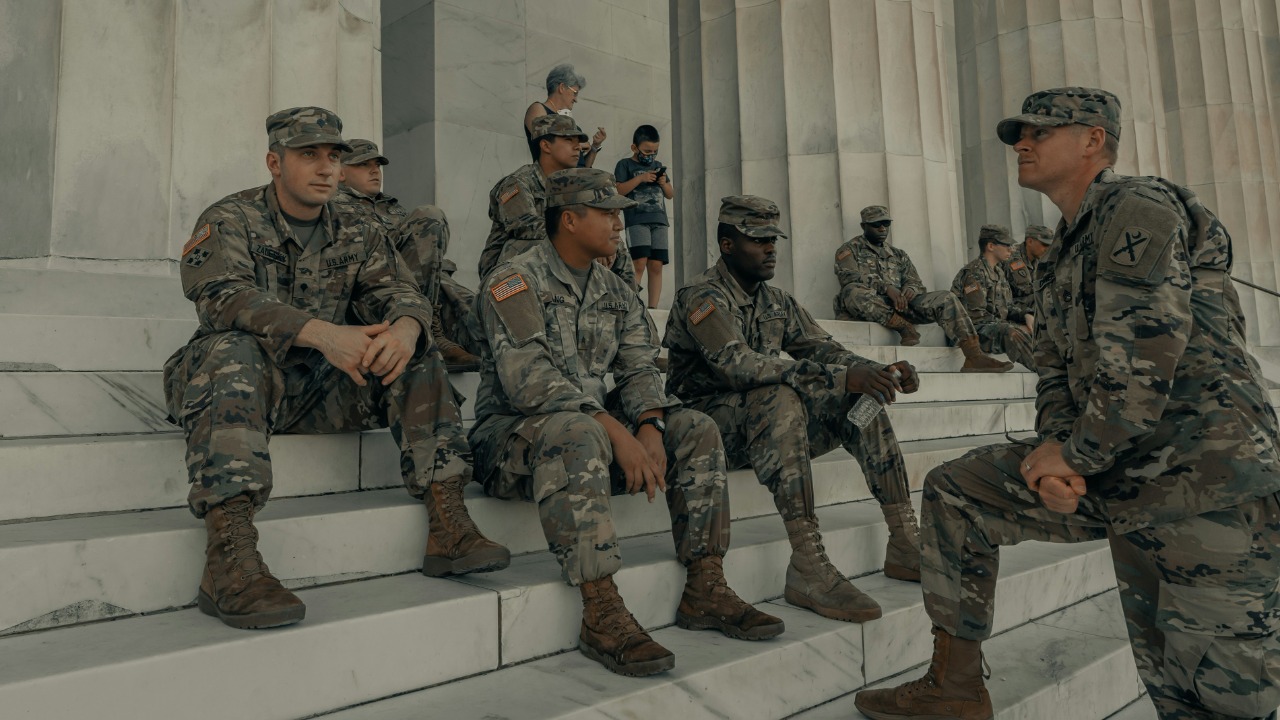
Two numbers landed in the same letter this year, and they move in opposite directions. Civilian federal employees will earn the same base salary in 2027 that they earn now. Service members, by contrast, are getting a raise that runs as high as 7 percent, depending on rank. Both figures came from the same three-page document, signed by President Trump, that reached the Speaker of the House at the end of August.
A Letter to Speaker Johnson Sets 2027 Civilian Pay at Zero
Trump transmitted the freeze in a letter to House Speaker Mike Johnson dated August 26, 2026. “I have determined that for 2027, base pay and locality pay for civilian Federal employees will not change from the 2026 rates,” he wrote in the transmittal, invoking his authority under 5 U.S.C. 5303(b) and 5 U.S.C. 5304a to set an “alternative plan” for federal pay whenever national emergency or serious economic conditions make the automatic formula, in his judgment, inappropriate.
The document, catalogued by the Government Publishing Office as House Document 119-189, was referred jointly to the House Committees on Oversight and Government Reform and Armed Services on August 27 and ordered printed. Civilian base and locality pay under the General Schedule and the other statutory pay systems named in the letter stays exactly where it sat in 2026, with no increase in January.
The programs nobody is enrolled in automatically: Each of the eleven has its own income limit and its own application, and none of them starts on its own. See the eleven programs in The Benefits Checklist.
Rank Sets the Number: 7.0, 6.0 and 5.0 Percent
Members of the Armed Forces get the opposite treatment. Citing his authority under section 1009(e) of title 37, United States Code, Trump set the 2027 monthly basic pay increase at 7.0 percent for grades E1 to E5, 6.0 percent for grades E6 to O3, and 5.0 percent for grades O4 and above, subject to the pay caps in 37 U.S.C. 203. The increase takes effect January 1, 2027, the same date civilian pay stays frozen.
The split by rank means the newest enlisted troops get the largest percentage increase in the table, while the most senior officers get the smallest. All three bands sit inside the range the letter itself sets up: a raise for the military as high as 7 percent while civilian rates hold flat.
Law Enforcement and Other Uniformed Services Get Separate Raises
Two more pay lines sit outside the alternative plan entirely. Trump directed the Office of Personnel Management to use its own statutory authority to raise 2027 compensation for federal law enforcement personnel by 3.8 percent, describing it in the letter as “a separate process from the establishment of this alternative pay plan.” OPM’s published guidance on the equivalent 2026 increase shows how that authority works: the agency sets special salary rates under 5 U.S.C. 5305 for categories such as Border Patrol agents, FBI special agents, Secret Service personnel and federal correctional officers, after consulting with the agencies that employ them.
Uniformed personnel who serve outside the Armed Forces — the commissioned corps of NOAA and the Public Health Service, among others — get a 3.6 percent increase effective the same January 1 date, set under 37 U.S.C. 1009(c).
The $26 Billion the White House Says the Freeze Avoids
The letter frames the freeze as a matter of arithmetic. Without an alternative plan, it states, locality pay for the civilian workforce “would automatically increase by an average of 20.6 percent, costing $26 billion in the first year alone,” on top of a separate 3.1 percent across-the-board increase to base General Schedule pay that would also take effect automatically. Trump called that combination “unacceptable” while “most Americans still struggle with the consequences” of prior inflation, and cited the goal of keeping federal agency budgets on “a fiscally sustainable course.”
That comparison is the crux of the zero: the automatic formula under current law would have produced a substantial raise for civilian employees, and the alternative plan sets it to nothing instead.
How an Alternative Pay Plan Becomes Final
A transmittal to Congress is not, by itself, a pay change. Under 5 U.S.C. 5303(b), the President can only set civilian pay this way as an alternative to the increase scheduled to occur automatically, and the plan becomes binding only once it is carried out through a formal pay order at year’s end. The same two-step process played out for the current year: the alternative plan for 2026 pay went to Congress on August 28, 2025, and it took legal effect only when Trump signed Executive Order 14368 on December 18, 2025, which set the actual General Schedule, locality and uniformed-services pay tables for the first full pay period of January 2026.
The 2027 letter, printed as House Document 119-189 and referred to committee on August 27, has reached that same starting point and no further. The determination it describes — no raise for civilian employees, 5 to 7 percent for troops by rank, 3.8 percent for law enforcement, 3.6 percent for other uniformed services — is the administration’s stated intent for January 2027. Locking those numbers in still requires the kind of implementing executive order that, on the 2025-into-2026 timeline, arrived in the middle of December.
Household Programs That Do Not Track a Raise
A federal pay freeze or a federal pay raise moves on its own schedule, set by an executive order at the end of the year. The benefit programs many households rely on run on an entirely separate timeline, each with its own paperwork and income limits that no pay adjustment — frozen or otherwise — ever touches.
The Benefits Checklist is a 69-page guide covering 11 benefit programs with the 2026 income limits and a 50-state phone directory.
See the 11 programs and their 2026 income limits in The Benefits Checklist.
AI-assisted research and drafting; reviewed by an editor.


