
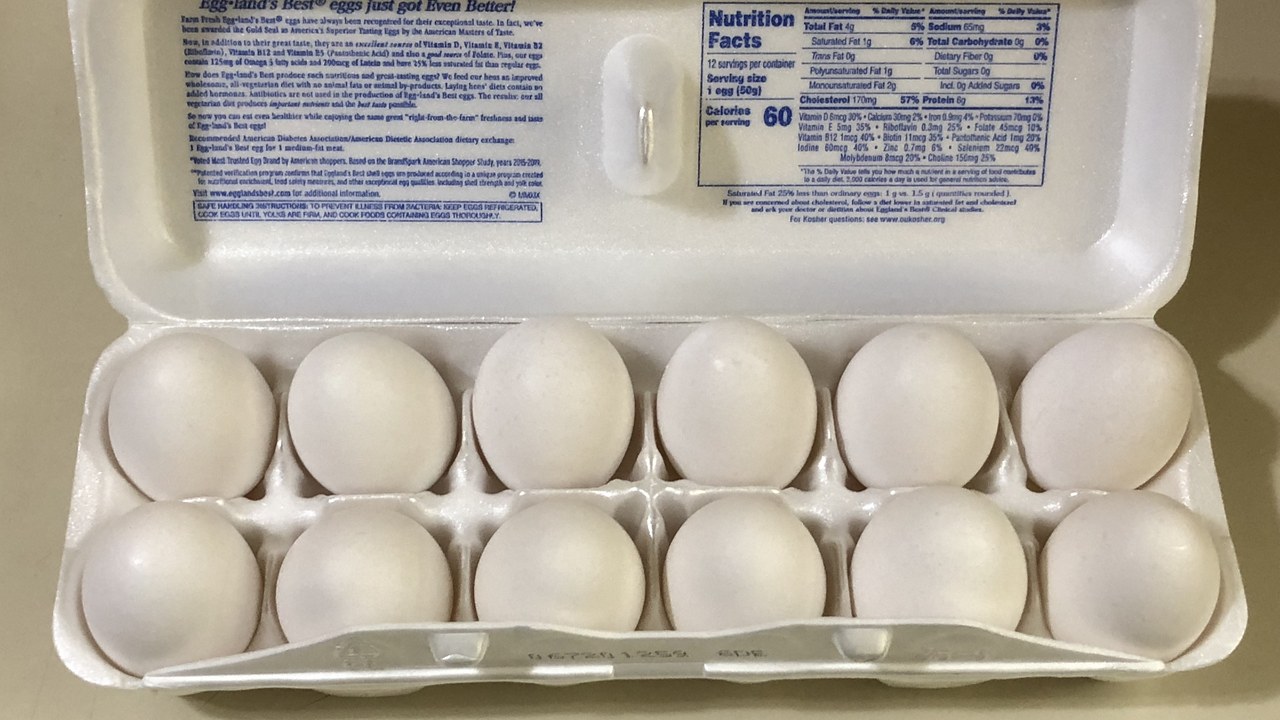
Grocery shoppers who watched egg cartons swing from record highs to sudden relief over the past four years are about to see one of the sharpest price moves yet. The Department of Agriculture’s Economic Research Service now projects retail egg prices will fall 30.8 percent for all of 2026, the single largest price change, up or down, among the 15 food categories in its latest monthly forecast. That drop would follow three straight years of increases driven by bird flu, and it lands even as several other grocery staples, led by beef, keep climbing. For a household working out what groceries cost this year, the number points to real relief in one aisle at the same time other aisles get more expensive.
The Bird-Flu Rebound Behind the 30.8 Percent Forecast
The size of the projected decline traces back to a disease outbreak that has driven egg prices since 2022. Highly pathogenic avian influenza has periodically forced producers to cull infected laying flocks, tightening the supply of eggs reaching store shelves each time it flared. Retail egg prices rose 32.2 percent in 2022, another 1.4 percent in 2023, 8.5 percent in 2024 and 21.9 percent in 2025 as the outbreak kept recurring.
That pattern reversed in 2026. Egg-laying flocks are recovering because fewer new HPAI cases turned up in the first quarter of the year than in the same period of 2025, and the supply of replacement pullets has been large enough to cover both routine flock turnover and unpredictable disease losses. Retail egg prices were already 25.7 percent lower in July 2026 than a year earlier, and the Economic Research Service’s August update put the full-year forecast at a 30.8 percent decline, with a 95-percent forecast interval running from a 35.3 percent drop to a 25.3 percent drop.
That interval is worth noting on its own. Even the low end of the agency’s uncertainty band still describes a decline of roughly a quarter. The statistical model behind the forecast does not show a realistic path back to higher egg prices for the year as a whole, only a question of how much lower prices land by December.
Free relief finder: Property-tax freezes, exemptions and utility help for older homeowners usually only apply after someone asks. See what to look for with the free relief finder.
Free download from RetireShield. Getting it also signs you up for the free Retirement Money Brief, a weekday email. Unsubscribe anytime.
Wholesale Egg Prices Are Falling Even Further
The retail number is not the steepest egg figure in the ERS report. On the wholesale side, farm-level egg prices rose 163.1 percent in 2022, fell 28.3 percent in 2023, then jumped 43.1 percent in 2024 and 31.6 percent in 2025 as the same avian flu outbreak repeatedly thinned flocks. For 2026, ERS forecasts farm-level egg prices to fall 82.1 percent, with a forecast interval of -85.5 to -75.2 percent, a far larger swing than the 30.8 percent projected at the grocery register.
The gap between the two numbers reflects how the supply chain absorbs price swings. Producer prices, what processors and distributors pay directly for eggs, are typically far more volatile than the retail prices consumers see, because retailers spread costs and margins across a broader set of products and are slower to pass savings, or spikes, straight through. Farm-level egg prices actually rose 27.3 percent from June to July 2026 alone, even as they sat 79.0 percent below where they had been a year earlier, a reminder of how much noise sits underneath a smoother annual retail trend.
Beef and Veal Prices Are Forecast to Keep Climbing
Eggs are the exception in this year’s forecast, not the rule. Beef and veal prices are projected to rise 9.8 percent in 2026, with a forecast interval of 7.0 to 12.6 percent, the largest increase among the 15 food-at-home categories ERS tracks and roughly the mirror image of the egg decline. Federally inspected beef production fell nearly 5 percent in July 2026 compared with a year earlier, and a cyclical contraction in the U.S. cattle herd is expected to push production lower still through the second half of the year.
Those supply pressures show up further back in the chain as well. Farm-level cattle prices are forecast to rise 9.9 percent in 2026, and wholesale beef prices are projected to increase 9.4 percent, both consistent with a herd that has been shrinking rather than rebuilding. Unlike the egg market, there is no flock-recovery story working in beef’s favor this year. The cattle cycle that pushed prices higher is expected to keep running through the rest of 2026.
Sugar, Vegetables and the Rest of the 2026 Grocery List
Outside of eggs and beef, the forecast is a mix of moderate increases. Prices for sugar and sweets are projected to rise 7.1 percent in 2026, a forecast interval of 6.0 to 8.2 percent, driven largely by candy and chewing gum, a category that includes most types of chocolate. Fresh vegetable prices are forecast to increase 5.9 percent, with retail prices in July 2026 already running 12.8 percent higher for fresh tomatoes, 7.5 percent higher for fresh lettuce and 3.4 percent higher for fresh potatoes than a year earlier.
Pork and poultry sit closer to flat, forecast to rise 0.8 percent and 0.5 percent respectively, and dairy prices are projected to hold unchanged for the year. Fats and oils are the only other category, besides eggs, forecast to decline in 2026. Taken together, the 15-category breakdown is less a single story than a set of separate supply situations, a recovering flock, a shrinking herd, a candy category still working through higher input costs, that happen to land in the same monthly report.
Why the Forecast Could Still Move Before Year’s End
The 30.8 percent figure is a projection, not a closed book. ERS builds the Food Price Outlook from a statistical model fitted to recent Consumer Price Index and Producer Price Index data, and the agency typically refreshes the forecast near the 25th of every month as new government price data arrives; the current release runs on July 2026 data, and the next update is scheduled for September 25, 2026.
Those monthly updates have been disrupted before for reasons that have nothing to do with egg supply. A federal government shutdown from October 1 to November 12, 2025 halted Bureau of Labor Statistics data collection entirely, and a separate stretch of delayed Producer Price Index releases pushed source data further behind into early 2026. ERS has documented both disruptions and how it estimated the missing months rather than skip a forecast. All food prices, meanwhile, are still projected to rise 3.0 percent in 2026 and food-at-home prices 2.5 percent, both figures from the same August release that put the egg forecast at 30.8 percent, a reminder that a cheaper carton of eggs this year is arriving inside a grocery bill that, overall, is still forecast to cost more than it did in 2025.
Property Taxes and Utility Bills Don’t Show Up in a Food Price Forecast
USDA’s forecast tracks what happens at the register. It says nothing about a property tax bill or a heating and cooling invoice, two of the largest fixed costs many older homeowners carry regardless of which way egg or beef prices move in a given year. Property-tax relief, circuit-breaker credits and utility assistance programs exist in most states, but they typically only reach households that know to apply, and the rules, forms and deadlines differ by state and program.
The Senior Property Tax & Home-Cost Relief Kit is an 11-page kit that walks through the 5 kinds of property-tax relief available across states, the circuit-breaker credit that includes renters, and heating, cooling and home-repair help programs.
See the full state-by-state relief breakdown in The Senior Property Tax & Home-Cost Relief Kit.
AI-assisted research and drafting; reviewed by an editor.


