
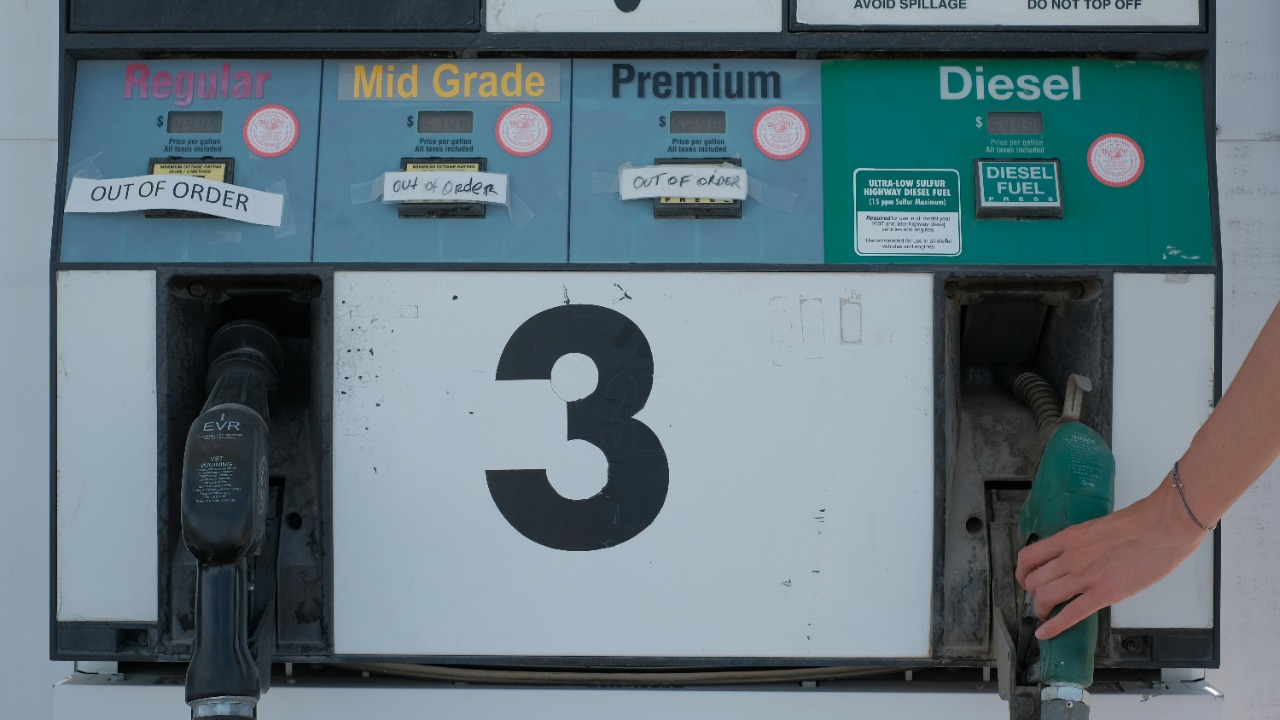
Two subtractions explain the headline. On-highway diesel averaged $6.382 a gallon in the week ending September 28, 2026, against $3.754 a year earlier, a gap of $2.628. Regular gasoline averaged $4.465 against $3.118, a gap of $1.347. Both figures come from the U.S. Energy Information Administration’s weekly survey.
The arithmetic, line by line
The EIA’s Gasoline and Diesel Fuel Update prints each price next to its year-earlier twin, and the differences come from those two numbers on the same page. The headline’s rounded figures follow directly.
- Diesel: $6.382 minus $3.754 equals $2.628, which rounds to $2.63 a gallon more than a year ago.
- Regular gasoline: $4.465 minus $3.118 equals $1.347, which rounds to $1.35 a gallon more.
Both prices are measured weekly averages, results rather than predictions. The page was released September 29, 2026, and lists the next release as October 6, 2026.
How much a fill-up changes
Per-gallon gaps are easier to feel once they are multiplied by a tank. A 15-gallon fill-up of regular gasoline costs $1.347 times 15, or about $20.21, more than it did at last year’s price. A 30-gallon diesel fill at the $2.628 gap costs about $78.84 more. These are the writer’s illustrations at the survey averages, not EIA figures, and pump prices in any given town sit above or below the national mean.
The regional table on the same page shows how far a national average can mislead. Regular gasoline on September 28 stood at $5.724 on the West Coast, the highest region, and $3.924 on the Gulf Coast, the lowest. California alone was $6.189.
Diesel’s longer reach
Diesel is the fuel burned by most heavy trucks, and the $2.628 rise is the larger of the two. The EIA survey does not measure how much of a diesel increase ends up on a grocery shelf, and no figure here claims one. What the survey does show is that the fuel cost faced by haulers has risen by more than half from a year earlier. Dividing, $2.628 by $3.754 gives a rise of about 70 percent for diesel, against about 43 percent for gasoline, which is $1.347 divided by $3.118.
What EIA expects for 2027
The agency’s Short-Term Energy Outlook, released September 9, 2026, is a forecast and should not be read as a price anyone has paid. It projects retail diesel averaging $5.07 a gallon in 2026 and $4.40 in 2027, and regular gasoline averaging $3.84 in 2026 and $3.35 in 2027. They are annual averages, so they blend the months already measured with those still ahead.
Next to the latest weekly readings, the 2027 forecasts sit well below. Diesel at $4.40 would be $1.98 under the September 28 price of $6.382, and gasoline at $3.35 would be $1.115 under $4.465. The outlook ties its price view to crude oil, forecasting Brent at $91 a barrel for 2026 and $74 for 2027, and it notes constraints on Middle Eastern oil exports continuing through the end of 2026.
The forecasts also say something about where prices are not expected to return. EIA’s 2027 gasoline average of $3.35 is still $0.232 above the $3.118 a year-ago price in the weekly survey, and its 2027 diesel average of $4.40 is $0.646 above the $3.754 year-ago price. In the agency’s own projection, in other words, fuel gets cheaper from here yet does not fall all the way back to where it stood a year ago.
The 2026 averages carry a similar message. Diesel’s latest reading of $6.382 is $1.312 above the $5.07 forecast for the full-year average, and gasoline’s $4.465 is $0.625 above the $3.84 average. Because the first nine months of 2026 are already part of those averages, a forecast below the current price implies lower prices in the months to come, or lower prices earlier in the year than today’s.
One week is a snapshot
The weekly figure is a single survey average, and a year-earlier comparison picks one week from last autumn as its baseline. A different base week would give a different gap. The EIA releases a new reading each week, which is why the October 6 release matters: it will show whether the $2.63 and $1.35 gaps widen, hold or shrink.
Fuel use under the new mileage rule
A separate federal action published the same week bears on gasoline demand over the long run. In a final rule published September 30, NHTSA estimates its new fuel-economy standards will mean a 4.6 percent increase in national gasoline consumption through 2050, measured against the No-Action baseline. That is a modeled comparison, and it does not predict what a pump will charge.
The weekly survey and the outlook are each updated on October 6, the same date for both. The EIA’s published figures for the week ending September 28 are the source for every measured price above, and its September outlook is the source for each forecast.
A kit for the winter bills that follow a fuel-price jump
Higher fuel prices come as the heating season starts, and older homeowners and renters often weigh energy costs alongside property taxes and repairs. The Senior Property Tax & Home-Cost Relief Kit is written for that overlap.
The Senior Property Tax & Home-Cost Relief Kit is an 11-page kit that includes heating, cooling and home-repair help and an application log and renewal calendar for tracking each program.
Look up the heating, cooling and home-repair help a household can ask about →
Drafted with AI assistance and checked against the EIA and Federal Register pages linked above.


