
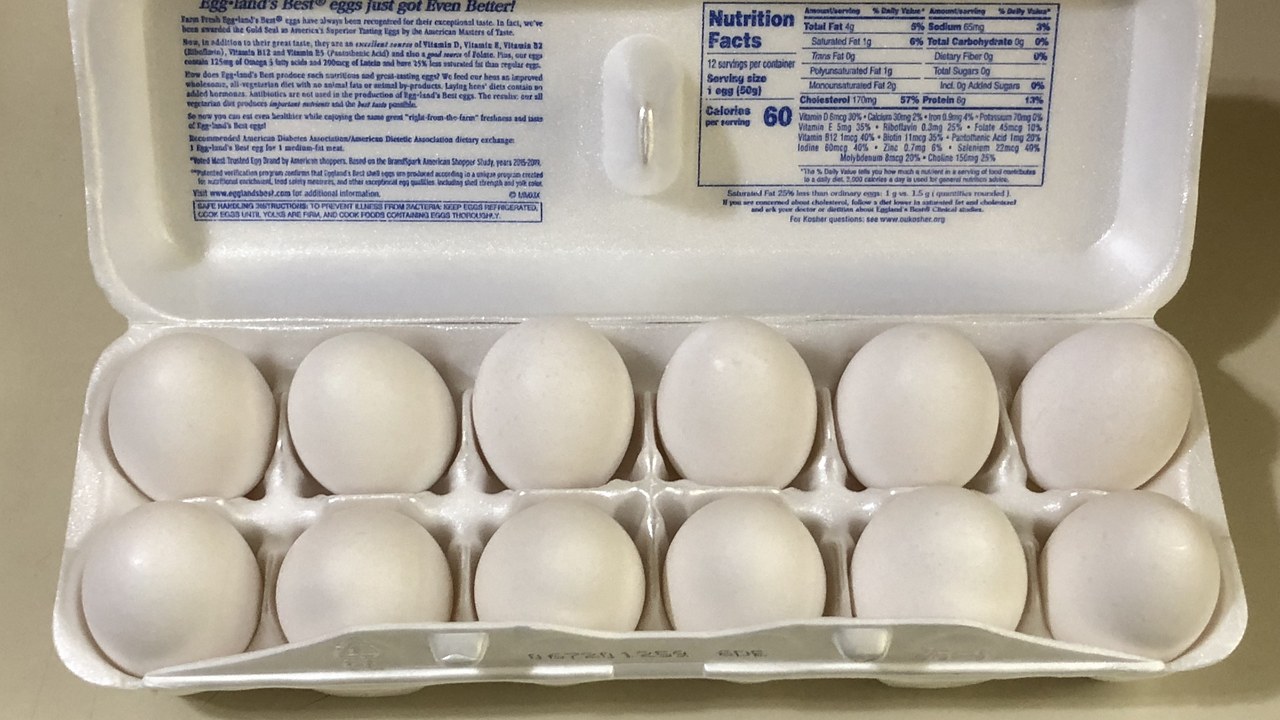
Eggs cost 23.0 percent less in August 2026 than in August 2025, and that is the number that has actually been measured. The bigger figure in the headline, 29.4 percent, belongs to a different category of claim. USDA’s Economic Research Service now forecasts that egg prices will fall 29.4 percent across calendar 2026, a prediction that is still partly unrealized.
What August recorded
The Economic Research Service’s September 25 summary reports what the Consumer Price Index showed for eggs in August. Compared with August 2025, egg prices were 23.0 percent lower. Compared with July 2026, they were 3.5 percent higher. Both are measured results, taken from price surveys that have already closed.
The two readings point in opposite directions without contradicting each other. Egg prices are still far below where they stood a year earlier, yet they ticked up in the latest month. A shopper who noticed a carton costing a little more in August than in July was seeing the same market that is down nearly a quarter over twelve months.
The monthly comparison and the yearly comparison use different baselines. The 3.5 percent rise measures August against the month just before it, while the 23.0 percent decline measures August against the month a year before. A single month of firming does not undo a year of lower prices, though a run of such months would pull the yearly decline toward zero. That is the pattern the next few readings will show or rule out.
What the 29.4 percent forecast adds
The forecast is another sort of statement entirely. In the same release, the agency says egg prices are “forecast to decrease 29.4 percent” for 2026, with a prediction interval of minus 32.9 to minus 25.2 percent. That is an annual average, comparing the whole of 2026 with the whole of 2025. It combines months that are already in the books with months that are not.
The interval has a width of 7.7 points, found by subtracting 25.2 from 32.9. Even the mildest end of it, a 25.2 percent fall, is steeper than the 23.0 percent measured for August. The summary does not break the annual figure into a month-by-month path, so the page does not say which months carried the sharpest declines. The arithmetic only shows that the full-year average has to be steeper than August alone if the forecast is to hold.
A 6.4-point gap, and how to read it
The forecast minus the measured August figure is 29.4 minus 23.0, or 6.4 percentage points. The gap should not be called an error. The two numbers answer different questions, one about a single month against the same month a year earlier and the other about a twelve-month average against a twelve-month average.
Where the gap matters is in a headline that says egg prices “are falling 29.4 percent.” Nothing on the page says that. What the page says is that the agency’s models expect the 2026 average to land about 29.4 percent below 2025’s, and that eggs were 23.0 percent below in the latest month measured.
Eggs against the rest of the basket
Eggs are an outlier in this release. The agency forecasts all food to rise 2.9 percent in 2026, with an interval of 2.5 to 3.2 percent, and food at home, the grocery-store portion, to rise 2.4 percent. Beef and veal is forecast to rise 9.4 percent, with an interval of 7.4 to 11.6 percent. A figure of 9.8 percent circulated earlier for beef, and the September summary does not support it.
A cheaper egg and a dearer steak can sit in the same basket. A household that buys a dozen eggs a week and beef once a month gets relief at the dairy case that the meat counter then claws back. Dairy is forecast to rise 0.1 percent for the year, poultry 1.0 percent and pork 1.2 percent.
Measured prices for the whole food category tell a quieter story. Compared with August 2025, all food was 2.7 percent higher, food at home 2.2 percent higher and food away from home 3.4 percent higher. From July to August, all food rose 0.1 percent and food at home was unchanged.
The next two checkpoints
A forecast of this kind is revised every month as new Consumer Price Index data arrive, which is why the egg figure can move even when no egg has changed price in the meantime.
Two scheduled releases will test the forecast. The Bureau of Labor Statistics, which produces the Consumer Price Index the outlook is built on, lists the September CPI release for October 14, 2026 at 8:30 a.m. Eastern. The agency’s Food Price Outlook page lists its next update for October 23, 2026, which will fold in that new reading and may move the 29.4 percent figure.
Until then, the careful way to describe the egg aisle runs in two sentences. Egg prices were 23.0 percent lower in August than a year earlier, according to measured data, and USDA’s Economic Research Service forecasts a 29.4 percent decline for the full year. Both come from the September 25 summary findings, which list Hayden Stewart, Diansheng Dong and Wilson Sinclair as the agency contacts for the outlook.
A kit for the larger housing bills behind a falling egg price
Cheaper eggs trim one line of a food budget, while property taxes, heating and home repairs are bills that move on their own schedules. The Senior Property Tax & Home-Cost Relief Kit is aimed at older homeowners and renters who want those costs in one place.
The Senior Property Tax & Home-Cost Relief Kit is an 11-page kit that explains heating, cooling and home-repair help and the circuit-breaker credit that includes renters.
See what The Senior Property Tax & Home-Cost Relief Kit covers →
An AI assistant helped draft this article, and each figure was checked against the USDA and Bureau of Labor Statistics pages linked above.


