
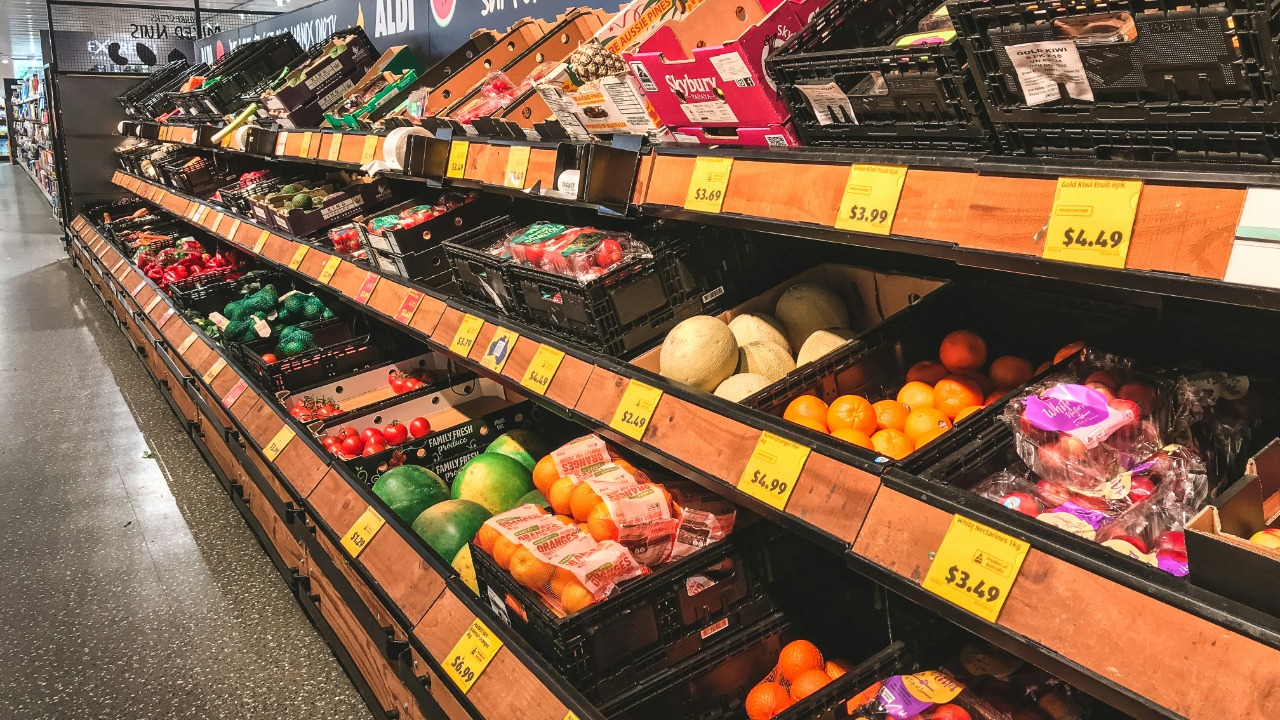
A 2-pound bag of Honeycrisp apples at Aldi now carries a $1.99 price tag, and family packs of Kirkwood chicken breast are $1.99 a pound. Both prices come from Aldi’s Sept. 23 fall price announcement, and the chain says they run through at least Nov. 3. Each is a claim by Aldi about its own shelf, measured against its own past prices.
Apples: about a dollar a pound
Two pounds for $1.99 comes to 99.5 cents a pound. In the release, Aldi says that bag is 35% cheaper than a year ago and the lowest price it has charged for Honeycrisp in more than five years. The bag sits among the seasonal produce reductions Aldi lists, and the five-year lookback is Aldi’s own, drawn from its records rather than from any outside price series.
Working backward shows what a 35% cut implies. If $1.99 is 65% of last year’s price, the earlier bag cost about $3.06 ($1.99 divided by 0.65), or roughly $1.53 a pound. Aldi does not print that earlier figure in the release, so the $3.06 is derived arithmetic, not a quoted price. The difference for a household that buys one bag a week through the promotion’s six weeks would be about $6.40, and only if it would have paid last year’s price.
Chicken breast at the lowest everyday price since 2022
The chicken claim is framed differently. Aldi calls $1.99 a pound for Kirkwood chicken breast family packs its “lowest everyday price since 2022.” That wording points to a multi-year comparison but names no earlier price, so the release does not let a reader compute a percentage cut. For a hypothetical 3-pound pack, the arithmetic is simple: 3 times $1.99 is $5.97.
It also matters that this is a store-brand product. Kirkwood is one of Aldi’s own store brands, which means the price cannot be matched line for line at another grocer. Comparing it with a national brand’s boneless breast at a competitor would be comparing different products with different trim, packaging and sourcing.
What the national data says about chicken and fruit
The USDA Economic Research Service’s Food Price Outlook, updated Sept. 25, supplies a backdrop. It reports that poultry prices rose 0.6% from July to August 2026 and stood 0.5% higher than in August 2025, and that retail fresh fruit prices fell 0.5% in the month but were 3.8% higher than a year earlier. It also forecasts food-at-home prices to rise 2.4% in 2026.
Those are national averages across many products, not a check on Aldi’s two items. They do show the direction Aldi is claiming to buck: chicken roughly flat and fruit noticeably dearer year over year at retail overall, against a chain saying a single apple bag is down by more than a third. Both can be true, since one item at one chain can fall well below an average that mixes thousands of products and stores.
Two items in a larger set of cuts
The apples and chicken are the headline examples in a broader release. Aldi says the reductions extend to pears, grapes, squash, fresh herbs, organic coffee, mixed nuts, dried fruit and paper towels, among other items, and that nearly one-third of its everyday assortment is priced below 2025 levels. Scott Patton, the company’s chief commercial officer, is quoted saying that value is a year-round promise, not a promotion.
That framing sits beside a stated end date. The release commits to the prices through at least Nov. 3, and a shopper who wants the apples for a holiday recipe has a definite window to buy inside. After it, the release says nothing.
What a shelf price claim leaves unchecked
Three limits apply to any grocery price announcement. First, the comparisons are Aldi’s, drawn from its own records of last year’s shelf. Second, a chain-wide price in a press release does not guarantee stock at every store, and seasonal fruit can sell out. Third, the release covers Aldi’s locations only, so what a bag of apples costs down the road remains a separate question.
The release does not state the weight of a family pack, so the per-pack total depends on what a given store stocks, while the per-pound price is the number to hold on to. The quickest independent check is the unit price printed on the shelf tag, per pound or per ounce, which allows a direct comparison across brands and bag sizes at any retailer. A $1.99 two-pound bag equals 99.5 cents a pound, and any competing bag can be converted the same way.
Aldi published the figures on Sept. 23, and the newsroom index lists that release as the most recent price announcement. Re-read on Sept. 30, it still showed the $1.99 Honeycrisp bag, the 35% comparison, the $1.99-a-pound chicken price and the Nov. 3 end date.
A place to track relief applications and renewal dates
Older homeowners and renters often hold several relief applications at once: a property-tax exemption, a utility assistance form, a repair-help request. Each carries its own renewal date, and missing one can mean waiting for the next cycle.
The Senior Property Tax & Home-Cost Relief Kit includes an application log and renewal calendar, along with heating, cooling and home-repair help details for each program.
Log relief applications and renewal dates in one place →
This piece was drafted with the help of an AI system and its figures were checked against Aldi’s release and USDA data.


