
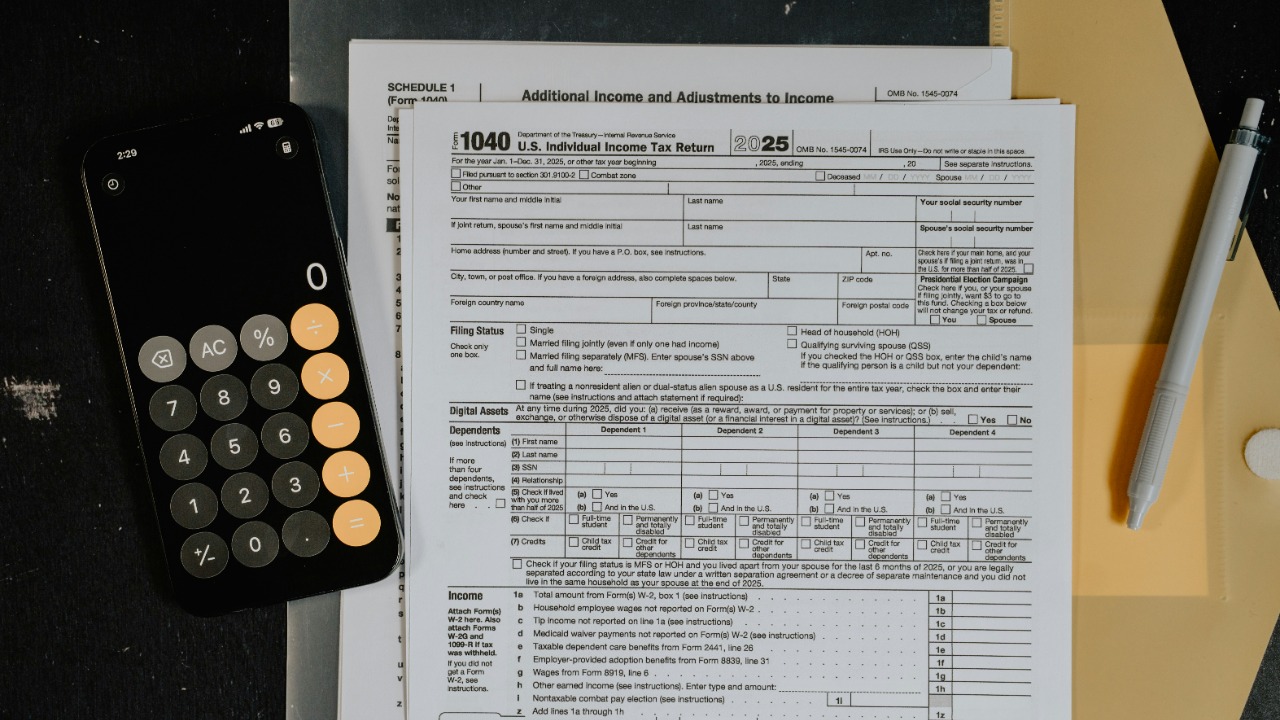
A congressional watchdog spent this year timing the Internal Revenue Service’s paperwork, and the numbers landed worse than the year before. A return dropped in the mail this spring sat in IRS’s processing pipeline roughly twice as long as one filed a year earlier, even as the agency finished the vast majority of everything it received. For a household waiting on a refund check rather than a direct deposit, that gap shows up as real weeks without the money.
GAO Times a Month-Long Wait for Paper Filers
The U.S. Government Accountability Office reviewed IRS’s return-processing and customer-service performance across the 2026 filing season, which ran from January 26 to April 15, 2026, and compared the results against the four seasons before it, back to 2021. In a report catalogued as GAO-26-109074 and publicly released August 10, 2026, investigators wrote plainly: “On average, it took IRS a month to process an individual paper return—about twice as long as last year.” The review was carried out under Jessica Lucas-Judy, GAO’s director of strategic issues, who examined the processing and service data IRS itself supplied for the season and interviewed IRS officials to identify what changed.
The slowdown does not show up in IRS’s overall completion rate. The agency finished about 98 percent of the roughly 177 million individual and business returns it received during the 2026 season, the same share it completed in 2025. Total volume moved through the system at close to the usual pace; it was specifically the paper share of that volume that stalled. GAO undertook the review because IRS entered the season with a smaller staff and new tax provisions to administer, and lawmakers wanted preliminary data on how the season actually went rather than waiting for a final year-end report.
What a stalled refund actually means: Each status message and each notice points to a different cause, and each cause has its own next step. Read the notice decoder in The IRS Refund Recovery Kit.
Half of Every Paper Return Passed Through an Outside Scanner
IRS did not process paper by hand alone. According to GAO’s full report, the agency sent about half of the paper returns it received to outside vendors, which scanned the documents and transmitted the data back to IRS electronically rather than routing every page through an IRS employee first. The arrangement was meant to speed intake by digitizing paper before staff ever touched it, converting a handwritten or typed form into a record IRS’s own systems could read without a person keying it in line by line. GAO found that paper processing still took longer in 2026 than in any of the prior seasons it reviewed, despite the added scanning capacity — evidence that outsourcing the scanning step alone was not enough to offset what was happening elsewhere in the pipeline.
Fewer Staff Left Processing Systems Unavailable
GAO traced part of the delay to IRS’s own explanation for it. The agency told investigators that some paper-processing systems were unavailable during the season, and that recent staff losses had delayed the programming updates those systems needed. IRS entered the 2026 season with a smaller workforce than in prior years and a set of new tax provisions to implement at the same time, a combination GAO cited as the backdrop for the delays in both return processing and customer service.
The staffing reduction reached beyond the mailroom. IRS answered about 2 million fewer telephone calls than the year before, and average call wait time rose to 8 minutes from 3 minutes in 2025, even though the agency fielded roughly 3 million fewer calls overall. In-person service fell too: IRS served about 626,000 taxpayers face to face in 2026, down 15 percent from the 740,000 served in 2025, a decline IRS officials attributed to fewer open locations and less walk-in demand.
A Month on Paper Versus Three Weeks by Direct Deposit
The gap between filing methods is not new, but the 2026 season widened it. IRS’s own current guidance tells filers to expect a refund status update 3 weeks after an electronic filing with direct deposit, versus 6 or more weeks after a mailed return. Layer GAO’s month-long paper-processing average on top of that baseline, and a return mailed this spring likely sat unprocessed for roughly the same stretch a direct-deposit filer waited for money already in the bank — before any additional review, correction or refund-trace request ever entered the picture. GAO’s own comparison implies how much the pace slipped: if a month this year was twice as long as last year’s average, a paper return in 2025 typically moved through IRS in closer to two weeks.
That timing difference lands hardest on the households least likely to file electronically in the first place, since a paper return is frequently the choice of filers without reliable internet access, a bank account for direct deposit, or comfort navigating tax software. For that group, the month GAO measured is not an abstract statistic but the actual stretch between mailing a return and knowing whether it was received at all.
Automation Answered More Calls While Fewer Staff Picked Up
IRS leaned harder on self-service in 2026 to offset the staffing gap. Automated systems answered 41 percent of the roughly 28 million calls IRS received, up from 34 percent the year before, meaning a larger share of callers resolved their questions without reaching a person. GAO’s review frames this as a deliberate rebalancing: with fewer customer service representatives available, IRS shifted more of its workforce’s attention toward correspondence and paper processing, leaving automation to absorb a growing share of the phone traffic that used to reach a live employee.
GAO ties the pattern to a single cause running through every metric in the report: with IRS’s workforce smaller than in prior seasons, the agency had to choose where its remaining staff spent their time, and phones, walk-in counters and the paper queue all lost out at once rather than one channel absorbing the strain alone.
A Month Inside the Processing Queue
GAO’s review measures how long the average paper return took to move through IRS — it does not address what a household should do once that month has passed and a refund still has not arrived, or how to prove a paper return was filed at all. Tracing a refund that never showed up, or a return that appears to have vanished into the queue, runs through a specific IRS form and a set of steps most households never see until they need them. A fixed deadline for claiming a refund also keeps running the entire time, whether or not the paperwork moved quickly.
The IRS Refund Recovery Kit is a 13-page kit built around the refund-trace steps for Form 3911 and the 3-year deadline for claiming a refund before it is forfeited.
Read the Form 3911 refund-trace steps and the 3-year deadline in The IRS Refund Recovery Kit.
AI-assisted research and drafting; reviewed by an editor.


