
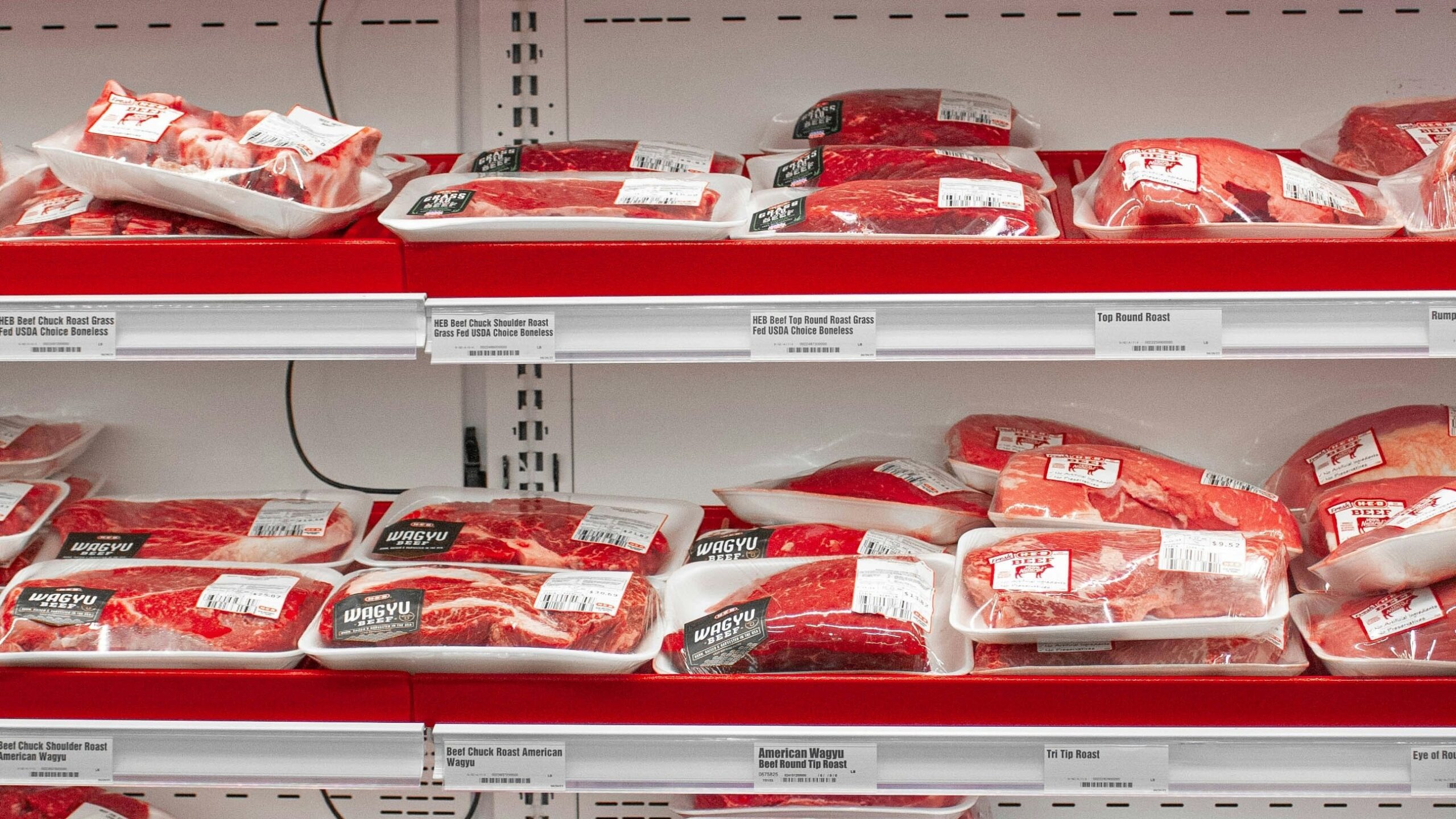
At the meat case, some sale tags moved this summer while the ground beef sticker did not. Government inflation data released this month track the item precisely: uncooked ground beef cost 7.2 percent more in August 2026 than a year earlier, and on a seasonally adjusted basis its price did not move at all during the month of August. Roasts and steaks sitting in the same display case slipped that month, which is likely where a shopper skimming past the ground beef package could get the impression that the whole beef case had cooled off.
The Government’s Own Line for a Pound of Ground Beef
The pattern shows up clearly once the item is isolated in the federal government’s own numbers. Uncooked ground beef carried a 7.2 percent increase over the twelve months ending in August 2026, measured without any seasonal adjustment, and a seasonally adjusted change of exactly 0.0 percent between July and August. A third figure, the unadjusted month-over-month change, put ground beef 0.6 percent higher in August than in July. None of the three measures shows a decline.
Those figures come from the Bureau of Labor Statistics’ detailed Consumer Price Index tables for August 2026, published September 11 as part of report USDL-26-1496, which lists uncooked ground beef on its own line inside the broader beef and veal category. The line is one of hundreds tracked every month under the Bureau’s broader Consumer Price Index program, which measures price movement item by item rather than relying on a single blended grocery figure. The distinction between seasonally adjusted and unadjusted numbers matters because grocery prices swing with the calendar every year regardless of underlying inflation; seasonal adjustment strips out that predictable pattern so a single month can be measured against the trend rather than against the season. On ground beef, both versions of the August reading agree: flat to slightly higher, not lower.
Free download: Property-tax freezes, exemptions and circuit-breaker credits, plus LIHEAP and shutoff protections, and what to gather before applying. Get the free property tax and utility relief finder.
Where the Beef Case’s August Dip Actually Happened
The impression of a broader beef discount is not imaginary; it is aimed at different cuts. The government’s combined beef and veal category, which rolls ground beef together with roasts, steaks and other cuts, fell 1.0 percent in August on a seasonally adjusted basis. Uncooked beef roasts drove much of that move, down 1.7 percent for the month, and uncooked beef steaks fell 1.5 percent alongside them. Ground beef sits inside that same combined category, yet its own line shows no decline at all.
A household that mostly buys ground beef would not have felt the August relief that a household buying roasts or steaks experienced, even though both technically shop from the same government category. The combined number can move because two of its three largest components moved, while the third held exactly where it was the month before. The two patterns sit side by side in the same weekly circular: a discount sign over the roast display and an unchanged price card over the ground beef bin.
Ground Beef’s Own Twelve-Month Climb Hasn’t Slowed
Zoomed out to a full year, every one of those cuts still costs more than it did in August 2025. Ground beef’s 7.2 percent annual increase sits between uncooked beef steaks, up 4.0 percent, and uncooked beef roasts, up 8.4 percent, over the same twelve months, while the broader beef and veal category that contains all three is up 5.9 percent. The Bureau’s Consumer Price Index summary for the same period puts the broader food-at-home index up 2.2 percent and the overall cost of living up 3.4 percent over the year, which means ground beef’s own twelve-month gain is running more than three times faster than the average grocery bill.
That gap is part of why an August pause reads as a footnote rather than as relief. A single flat month does not undo most of a year spent climbing, and ground beef’s year-over-year number has not eased in the way the broader beef-and-veal category’s monthly figure briefly did.
Why a Blended Product Can Hold Steadier Than a Single Cut
Ground beef is typically produced from trim gathered across multiple parts of the animal, rather than from one specific muscle the way a roast or a steak is cut. That blending tends to smooth out the kind of short-term promotional swings that show up on whole-muscle cuts, which a store can discount individually to move inventory in a given week. A steak or a roast going on sale for a stretch shows up quickly in the following month’s average; a product built from a rotating mix of trim tends to respond more slowly to any single week’s retail promotion.
None of that changes what the government’s own August reading shows on the specific line item named uncooked ground beef: the price simply did not move, up or down, once the usual seasonal pattern is stripped out. Ground beef, roasts, steaks and the beef-and-veal aggregate that contains all three are still higher than a year ago despite August’s mixed results, so a slower-moving line item in any given month is not the same thing as a cheaper one.
What the Next Reading Will Show
The same summary confirms the Bureau of Labor Statistics has already scheduled its next full Consumer Price Index report for October 14, 2026, the point at which September data will show whether ground beef’s flat August was a pause or the start of an actual reversal. Until then, report USDL-26-1496 stands as the most current government reading on the item, and it describes a price still 7.2 percent higher than a year ago and unmoved during the most recent month measured. For a household buying the same package every week, the combination of a flat month sitting inside a year of steady increases is the more relevant read than the aggregate figure’s single-month dip.
The Grocery-Aisle Reading That Skips the Property-Tax Bill
A flat month at the meat case does nothing to the two largest fixed costs sitting on most household budgets: property taxes and home energy bills, which move on their own separate schedule and rarely arrive with a plain-English explanation attached. Relief programs for both exist in nearly every state, but most require a form that has to be found and filed before any of it applies.
The Senior Property Tax & Home-Cost Relief Kit lays out the circuit-breaker credit that includes renters and an application log and renewal calendar.
Look up the heating, cooling and home-repair help in The Senior Property Tax & Home-Cost Relief Kit.
AI-assisted research and drafting; reviewed by an editor.


