
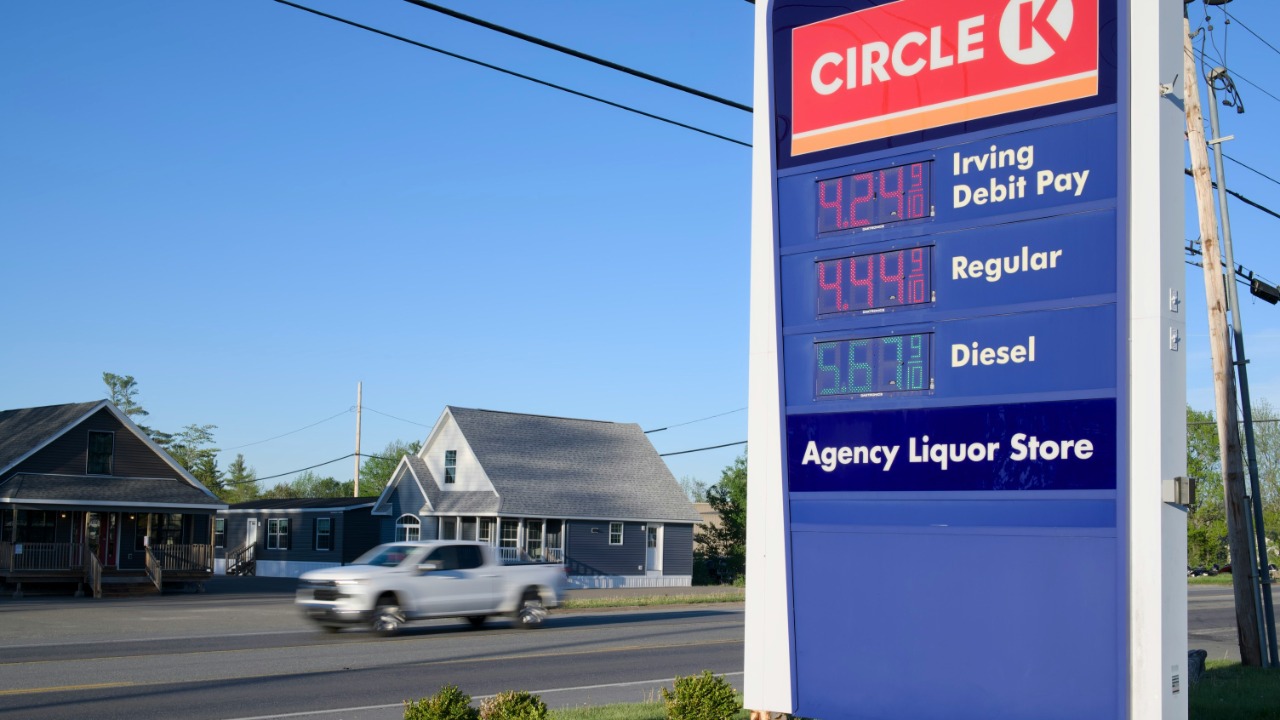
Diesel fuel has climbed sharply over the past year, and the increase touches far more than what shows up at a truck stop pump. Nearly every packaged, fresh, or frozen item that reaches a grocery store shelf spends at least part of its trip on the back of a truck, so a move this size in the price of the fuel that powers those trucks works its way, in some form, into the cost of getting food from a farm or a factory to a checkout line. The scale of the increase, and the slow, partial way it shows up in a retail price tag, both trace back to a fairly narrow set of numbers kept by federal energy regulators and the trucking industry’s own cost trackers.
What the Energy Information Administration’s weekly numbers show
The U.S. Energy Information Administration tracks a weekly average retail price for on-highway diesel fuel through its Petroleum and Other Liquids data program, the same office that publishes weekly gasoline prices. Diesel differs from gasoline in one important way for this story: it is burned almost entirely by commercial trucks, buses, and industrial equipment rather than passenger cars, so its price moves track commercial freight costs more directly than what most drivers notice at a corner gas station.
The agency’s own weekly series puts the U.S. average diesel price at $3.739 a gallon for the week ending September 15, 2025, and at $6.285 a gallon for the week ending September 14, 2026, the most recent figure in its current weekly report. That same historical price series, which the agency has maintained since 1994, shows the twelve-month change comes to $2.546 a gallon, or about 68 percent.
Diesel is the fuel used by nearly the entire fleet of heavy trucks that haul freight across the country, so a move of this size does not stay confined to a fuel gauge. It shows up first on a trucking company’s own cost sheet, and only later, if at all, in what a shopper pays.
Free relief finder: Property-tax freezes, exemptions and utility help for older homeowners usually only apply after someone asks. See what to look for with the free relief finder.
Why nearly everything on a grocery shelf rides on a truck at some point
The American Trucking Associations, the industry’s national trade group, estimates that trucks moved roughly 72.7 percent of the nation’s freight by weight in 2024, more tonnage than every other mode of transportation combined, including rail, water, air, and pipeline. The group also put the industry’s gross freight revenue at an estimated $906 billion for that year, a figure that includes what food manufacturers, grocery distributors, and retailers pay to move goods.
Rail and cargo ships carry a large share of raw grain, produce, and packaged goods over the longest distances, but almost none of that freight reaches a warehouse loading dock, let alone a store’s backroom, without a final leg by truck. That is the piece of the supply chain a diesel price move touches directly: the trip from a regional distribution center to the store shelf, and often the longer haul that gets a shipment to that distribution center in the first place.
How much of a trucking company’s cost sheet is actually fuel
The American Transportation Research Institute, a nonprofit that publishes the trucking industry’s most closely watched annual cost benchmark, put the industry-average cost of operating a truck at $2.336 a mile in 2025, a 3.4 percent increase from the year before, according to its 2026 Operational Costs of Trucking update. Fuel accounted for close to $0.482 of that per-mile figure, a little over a fifth of the total. Every other line item, including driver pay, insurance, tolls, tires, and repair and maintenance, made up the remaining $1.854 a mile.
Diesel taxes add another layer on top of the retail price EIA tracks. The American Trucking Associations reports that the federal government collects 24.4 cents in tax on every gallon of diesel sold, with states adding an average of another 31.8 cents.
Because fuel is a real cost but not the majority of what it takes to move a truckload, a jump in the price of diesel does not translate dollar-for-dollar into a matching jump in what a shipper pays to move a truckload of groceries, let alone what a shopper pays at checkout.
What keeps a diesel spike from showing up as a matching price increase in the store
Much of the truckload freight that moves groceries is booked under contracts that run for months or, in some cases, years at a time, rather than bought fresh on the spot market week to week. A spike in diesel prices phases into a shipper’s costs as those contracts come up for renewal, instead of arriving all at once the way it does for an independent trucker filling up at a retail pump.
Transportation is also only one link in a chain that runs from a farm or factory through a processor, a warehouse, a distributor, and finally a retailer. Each link in that chain can choose to absorb a cost increase, negotiate around it, or pass along only part of it in the price on a shelf tag, which is why a 68 percent move in one input rarely produces anything close to a 68 percent move in a finished grocery price.
The EIA updates its diesel price series every Monday, with the next release scheduled for September 22, 2026, giving households and businesses alike a running, public record of whether this particular increase keeps climbing or starts to level off.
The Forms Behind Property-Tax and Utility Relief
A diesel-driven rise in freight costs is one more line item pressing on a household budget that is already stretched by property taxes and utility bills that rarely move in a household’s favor. Relief for both exists in most states, but assessors and utility companies do not apply it automatically; a homeowner or renter typically has to identify the right program and file the paperwork.
The Senior Property Tax & Home-Cost Relief Kit opens with the circuit-breaker credit that includes renters and heating, cooling and home-repair help, then walks through the rest of its five property-tax relief categories with an application log and renewal calendar attached.
Read the circuit-breaker credit that includes renters in The Senior Property Tax & Home-Cost Relief Kit.
AI-assisted research and drafting; reviewed by an editor.


