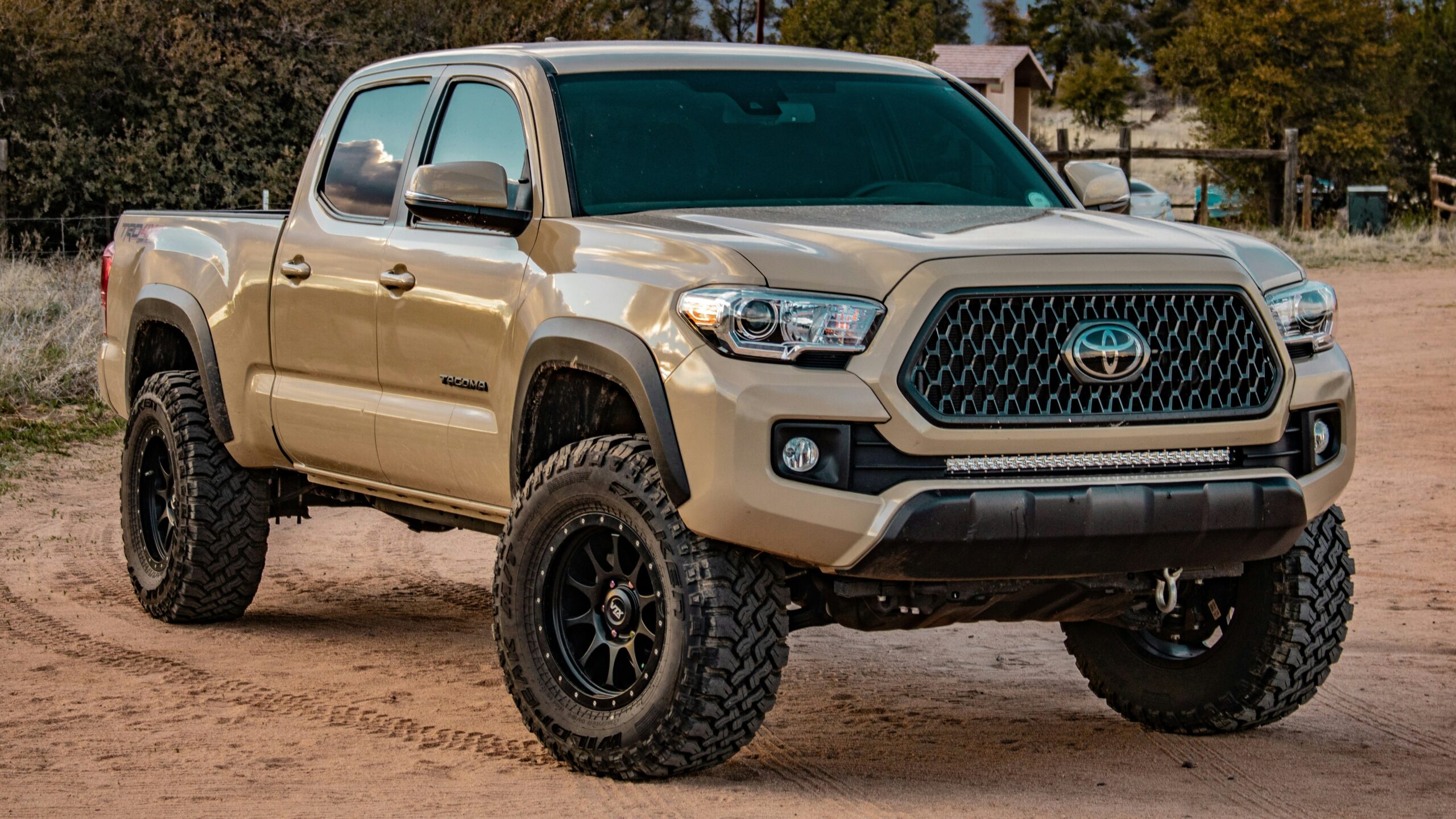
Toyota is recalling 48,280 Tacoma pickups after finding that the external oil reservoirs on certain shock absorbers can corrode where they are welded to the shock body, letting the reservoir break loose and land in the road while the truck is moving. The recall does not cover every 2024 or 2025 Tacoma — only those built with a specific Bilstein-brand shock absorber during a defined production window. For a household that leans on a Tacoma as a work truck or daily driver, the fix costs nothing at a Toyota dealer, but the truck first has to be confirmed as one of the affected vehicles.
The recall runs under NHTSA campaign number 26V514, filed by Toyota Motor Engineering & Manufacturing on August 6, 2026. Toyota’s own safety recall report traces the defect to a welded joint that can corrode from the inside out, sometimes without any visible damage to the paint or protective coating on the outside of the shock.
What NHTSA Recall 26V514 Covers
Toyota’s Part 573 Safety Recall Report filed with NHTSA lists 48,280 vehicles as potentially involved, split into two populations: 43,827 model-year 2024-2025 Tacoma trucks and 4,453 model-year 2024 Tacoma Hybrids. Both groups were built between January 2, 2024, and November 25, 2024, though Toyota notes that not every truck produced in that window was sold in the United States or equipped with the affected parts.
Eligibility comes down to hardware, not trim level. The recall covers trucks fitted with front and rear shock absorbers supplied by Thyssenkrupp Bilstein of America that use an external oil reservoir attached by a welded metal flange. Toyota’s filing identifies four specific component part numbers tied to the recall: two front shock assemblies and two rear shock assemblies. A Tacoma built outside that parts list, even in the same model years, is not included.
Free retirement updates: Enrollment and claim windows come and go, and missing one can cost you real money. The free Retirement Shield newsletter keeps you ahead of the deadlines that matter. Sign up free.
How a Corroded Weld Lets a Shock Reservoir Come Loose
The reservoir sits alongside the shock body and holds extra oil that helps the suspension manage heat during hard use. It is attached with a welded flange, and the untreated metal surfaces between the flange, the reservoir and the shock body can absorb moisture over time. As corrosion builds in that confined space, it puts expansive pressure on the welds holding the reservoir in place. Enough pressure can cause the welds to fail.
Once a weld fails, two things can happen. The shock can lose oil and lose damping control at that corner of the truck, which shows up as extra bouncing or a looser feel over bumps. And the reservoir itself, no longer secured to the shock, can separate entirely and fall onto the roadway, where it becomes a hazard for the Tacoma’s driver and for anyone traveling behind it.
The Free Repair and When Owners Will Hear From Toyota
The remedy described in Toyota’s filing is a dealer inspection of both the front and rear shock absorber assemblies on every included truck, with any affected assemblies replaced with improved parts at no charge. Toyota notified its dealer network on August 6, 2026, and plans to mail owner notification letters in phases between September 21 and October 5, 2026. A general reimbursement plan is on file for an owner who already paid to fix the same condition before the recall was announced.
Toyota’s recall announcement confirms the repair carries no cost to the owner. There is no need to wait for the mailed letter before scheduling service; a dealer can check a VIN and confirm parts availability as soon as an owner calls.
How Toyota Traced the Problem Back to Two Warranty Claims
Toyota’s chronology in the recall filing starts in September 2025, when the company received two allegations of a leaking shock absorber. A dealer inspection of one truck found a leaking left-rear shock with its external reservoir missing entirely. That prompted Toyota to recover parts from the field and begin teardown testing with the supplier.
Starting in November 2025, Toyota ran dynamic testing that deliberately induced reservoir detachment to study what happens on a moving vehicle, confirming the road-hazard risk before the company fully understood what was causing the welds to fail. Between January and April 2026, Toyota bench-tested new parts under combined rock-chipping and salt-spray exposure across 600-, 900- and 1,600-hour cycles, but could not fully reproduce the corrosion seen on parts pulled from the field. A computer analysis of weld strength that followed, between April and June 2026, showed the two lowest welds on the flange were likely to fail first, matching the pattern on recovered parts. A dye-penetrant test then showed that corrosion could reach the untreated metal even when the shock’s exterior paint and coating looked undamaged.
Toyota decided to conduct the voluntary recall on July 30, 2026. As of July 27, 2026, the company’s engineering review counted 20 Field Technical Reports and 62 warranty claims from U.S. sources tied to the condition — the evidence base behind the decision, not a count of trucks that actually lost a reservoir on the road.
Checking a VIN and What to Watch For Before the Letter Arrives
Toyota’s recall filing lists the remedy as a dealer inspection and, where necessary, replacement of the affected shock assemblies — it does not direct owners to stop driving an affected truck while they wait for the mailed notice. That does not mean the condition should be ignored in the meantime. Warning signs worth an early dealer visit include oil or wet residue on a front or rear shock, fluid pooling underneath the truck, a reservoir that looks loose or misaligned, a new clunk or rattle from the suspension, or noticeably more bouncing after a bump.
A Tacoma owner does not need to wait for the mailed notice to find out whether a specific truck is included. A dealer can run the 17-character VIN and check it against NHTSA campaign 26V514 or Toyota’s internal campaign numbers 26TB14 and 26TA14, and the same VIN can be checked directly through NHTSA’s own recall lookup tool without waiting for a dealer. Because the recall is defined by which shock absorber parts a truck actually carries rather than by trim badge alone, a VIN check is the only way to know for certain, especially on a truck that has had prior suspension work done.
This article was produced with AI assistance and reviewed by a human editor. Figures are linked to their primary sources; where a claim could not be verified from the public record, we say so.
More Financial Reading