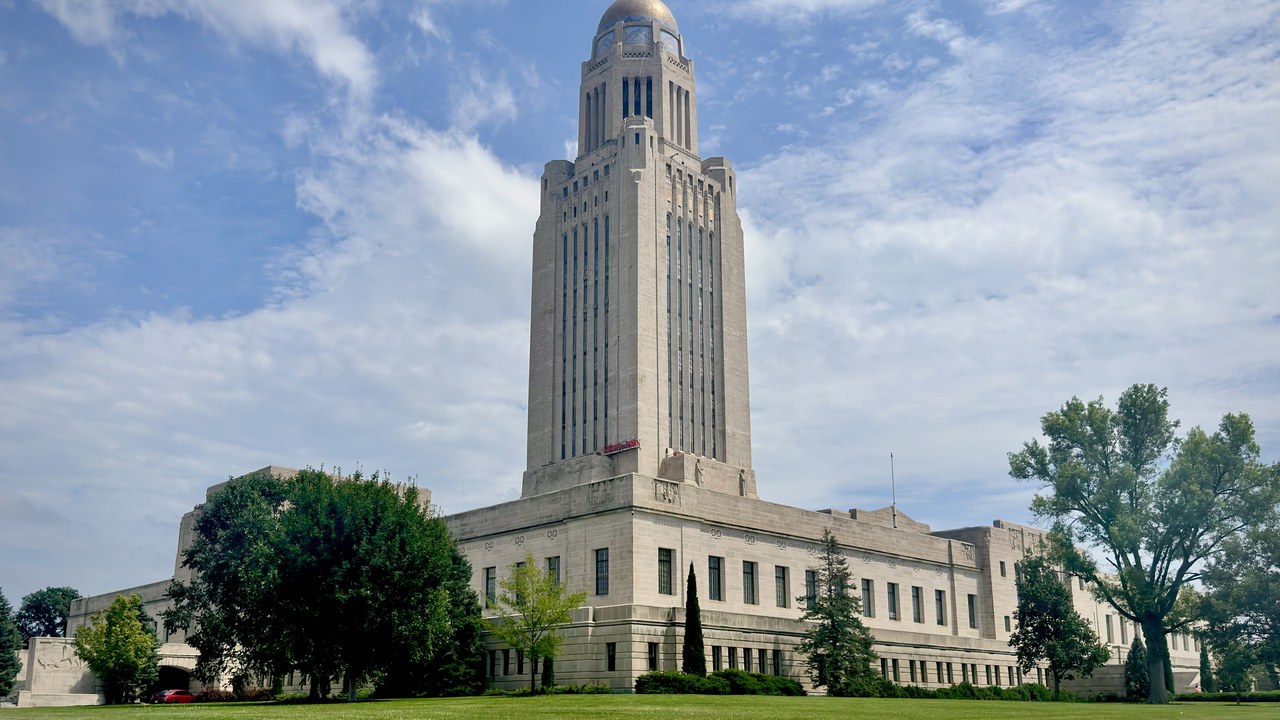
For more than a year, Medicaid work requirements have been an argument about projections, paperwork and what might eventually happen to somebody. In Nebraska, the argument ended. The state has started removing adults from Medicaid for failing to document enough qualifying hours in a month, and it is the first state in the country to actually do it. Every other state that expanded Medicaid is now working against a clock.
Nebraska began checking hours for coverage periods ending on or after July 31
The state’s Department of Health and Human Services put the start date in writing on its own work requirements page: “DHHS will first start checking work requirements for members whose coverage periods end on or after July 31, 2026.” That one sentence is what separates Nebraska from every other expansion state. Elsewhere the requirement is still being designed, staffed and coded. In Nebraska it is running.
The mechanics are month by month rather than a single mass review. Because each enrollee’s coverage period ends on its own schedule, the checks arrive in rolling cohorts, and the first of those cohorts produced the first terminations at the start of August. That design matters for anyone reading a headline number: what gets reported is one month’s slice, not the whole population.
Free retirement updates: Social Security and Medicare change every year, and nobody sends you a memo. Our free Retirement Shield newsletter breaks down what changed and what to do. Get it free in your inbox.
What 80 hours a month actually requires, and who has to prove it
The requirement is written in hours, not in jobs. Nebraska tells enrollees they “must spend at least 80 hours in at least one calendar month doing one of these activities” — a framing that reaches beyond paid employment, but still demands that the hours be documented rather than assumed.
The population subject to it is narrower than “people on Medicaid.” According to the state, it applies to enrollees who are between age 19 and 64, are not pregnant, do not have a disability, are not enrolled in Medicare, and meet income limits tied to 138% of the federal poverty level. Older adults on Medicare sit outside it. So do people with a qualifying disability and enrollees who are pregnant.
What remains is the expansion population: working-age adults, a great many of them in hourly, seasonal or shift work where clearing 80 hours in a particular calendar month is a scheduling outcome rather than a personal choice. A slow month at a restaurant, a stretch of cancelled shifts, an employer cutting back after the holidays — each is a documentation problem under a rule that measures a single month at a time.
The 200 figure is a state official’s estimate, and one group says the real scale is far larger
Be precise about what that number is. Nebraska’s Medicaid and Long-Term Care Director, Drew Gonshorowski, said the first round of disenrollments would remove around 200 Nebraskans from coverage, in remarks reported by Nebraska Public Media on July 31. That is an official’s estimate for the first monthly cohort. It is not an audited count from a DHHS report, and it is not a running total for the year.
Nebraska Appleseed, an advocacy group, said it had never heard the 200 figure before and had previously estimated that up to 40,000 Nebraskans could eventually lose coverage. Those two numbers are not necessarily in conflict. One describes a single month’s opening cohort under a rolling system; the other is a cumulative projection across time. The distance between them is exactly what the next several months of checks will settle.
January 1, 2027 is the compliance deadline for the remaining expansion states, with one exception
The requirement comes from section 71119 of the 2025 budget reconciliation law, and states do not get to opt out of it. Expansion states must have the community engagement requirement in effect by January 1, 2027. The Congressional Budget Office describes the statutory window plainly: “states may begin imposing the requirement starting on January 1, 2027, but must do so by January 1, 2029.”
That later date is an exception, not a general reprieve. The law permits the Department of Health and Human Services to grant a state that is demonstrating a good-faith effort to comply an exemption that can run no later than December 31, 2028. A state that has simply not bothered does not qualify for extra time. A state that can show it is genuinely standing up the system can be given it. For a household, the practical reading is that January 1 is the date to plan around unless your own state has publicly secured that exemption.
CBO projected $317.0 billion in deficit reduction and 5.3 million more uninsured
The fiscal case is where the requirement came from. CBO estimates that “implementing section 71119 will decrease deficits by $317.0 billion over the 2025-2034 period,” and, in the same analysis of the law’s Medicaid provisions, that “the number of people without health insurance will increase by 5.3 million in 2034.”
A larger figure, roughly $326 billion, circulates alongside those. It is a real number describing something different: a reduction in federal Medicaid spending over ten years, not deficit reduction. The gap, about $8.65 billion in decreased federal revenues, is why the two do not match — and why treating them as interchangeable misstates what CBO actually said.
Nebraska is now the live test of whether either projection holds. Its opening cohort was an estimated 200 people in a single month. The cohorts behind it arrive on the same rolling schedule DHHS described, one coverage period at a time, and they will say more about this rule than any ten-year estimate can.
This article was produced with AI assistance and reviewed by a human editor. Figures are linked to their primary sources; where a claim could not be verified from the public record, we say so.
More Financial Reading